
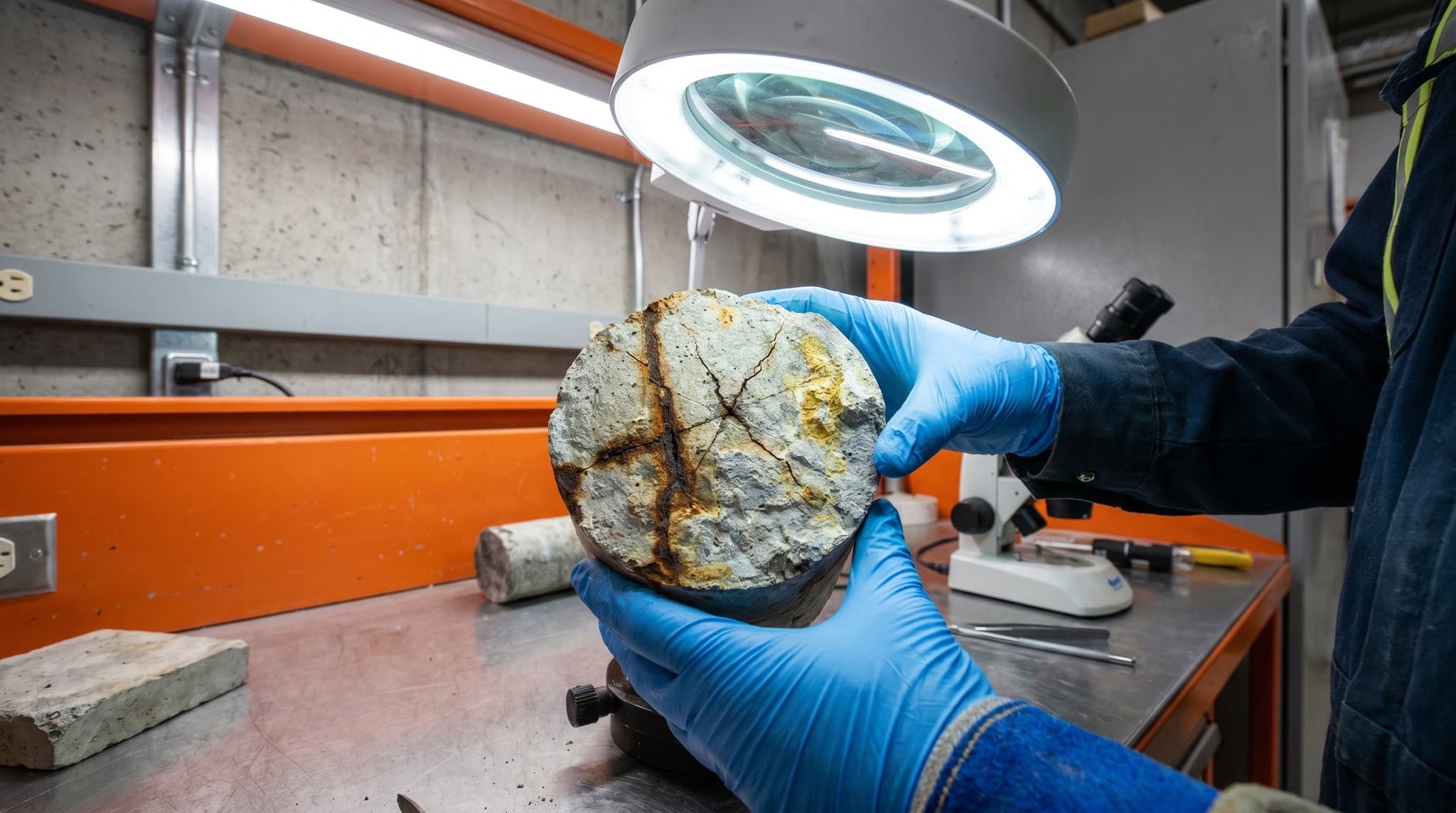
Pyrite in the foundation — diagnosis, testing and solutions in Lanaudière
A basement slab that lifts, star-pattern cracks spreading from the centre of the floor, backfill under the slab that swells year after year: pyrite is a silent but costly problem that affects hundreds of homes across Lanaudière, particularly in Mascouche, Terrebonne and along the North Shore. Imperméabilisation GSV diagnoses pyrite, arranges the CTQ-M-200 laboratory test and presents the solutions that fit your case — over 30 years of experience.
What is foundation pyrite?
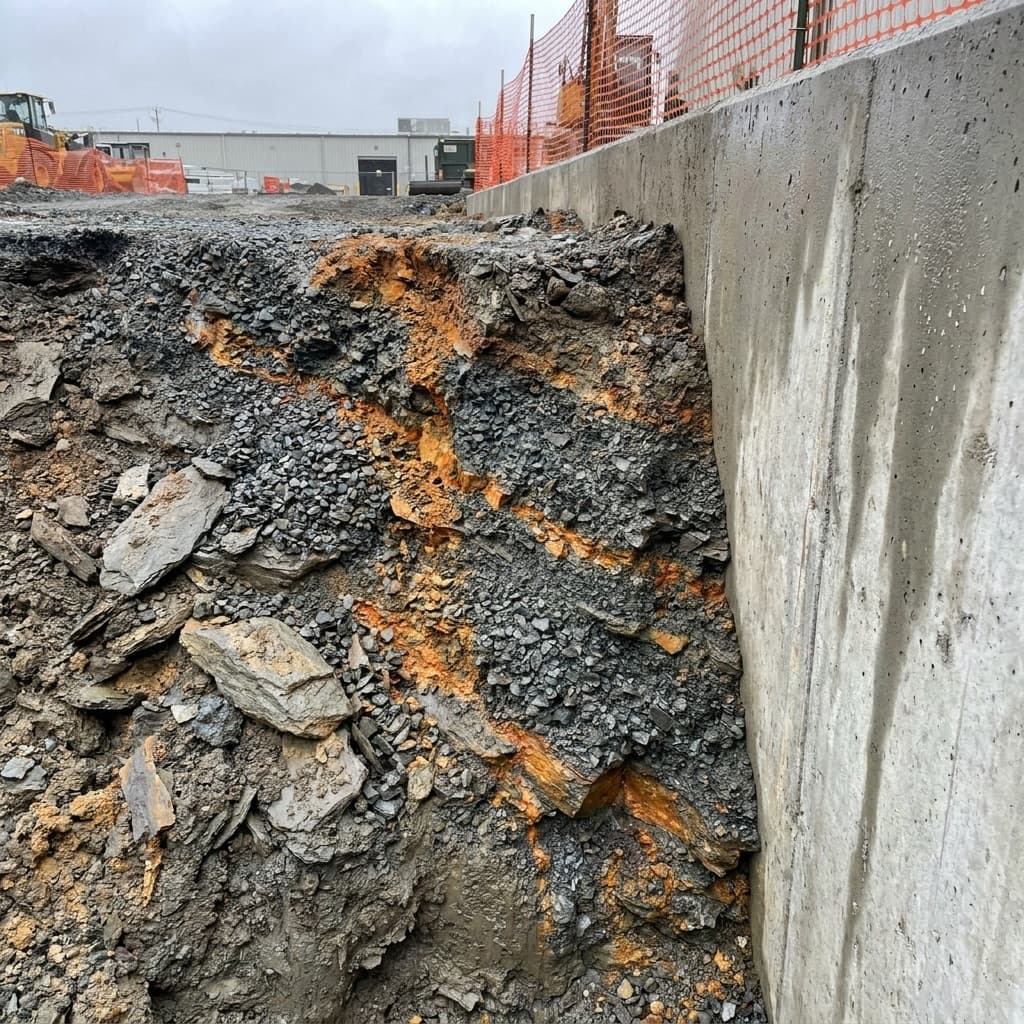
Pyrite is a natural mineral — an iron sulphide (FeS2) — present in certain sedimentary rocks used as crushed-stone backfill under basement slabs, under footings and around foundations. In the presence of water, oxygen and certain soil bacteria, pyrite slowly oxidizes and converts to iron sulphate and eventually to gypsum. That chemical change comes with a significant volume increase: a pyritic backfill can swell by several percent over the years, which is more than enough to lift a concrete slab, crack a footing and deform an entire structure from below.
In Quebec, pyrite became a major issue through the 1990s and 2000s, especially in the Greater Montreal area and on the North Shore. A significant share of the backfill sold at the time came from quarries whose crushed stone carried high sulphur levels. Municipalities historically the most affected include Mascouche, Terrebonne, Repentigny, L'Assomption, Charlemagne and several pockets of Laval. Government takeover programs existed at different times to help affected homeowners, but those programs no longer cover new files today: the cost of repair falls directly on the homeowner — or on the seller when a hidden-defect claim succeeds.
What makes pyrite unusual is that it acts slowly and invisibly for years before the first symptoms appear. A home built on pyritic backfill can look perfect for 5, 10, sometimes 15 years before the slab begins to lift, crack or push against the interior partitions. By the time the signs become obvious, the oxidation is already well advanced — and only a laboratory test objectively confirms the cause.
How do you know if you have a pyrite problem?
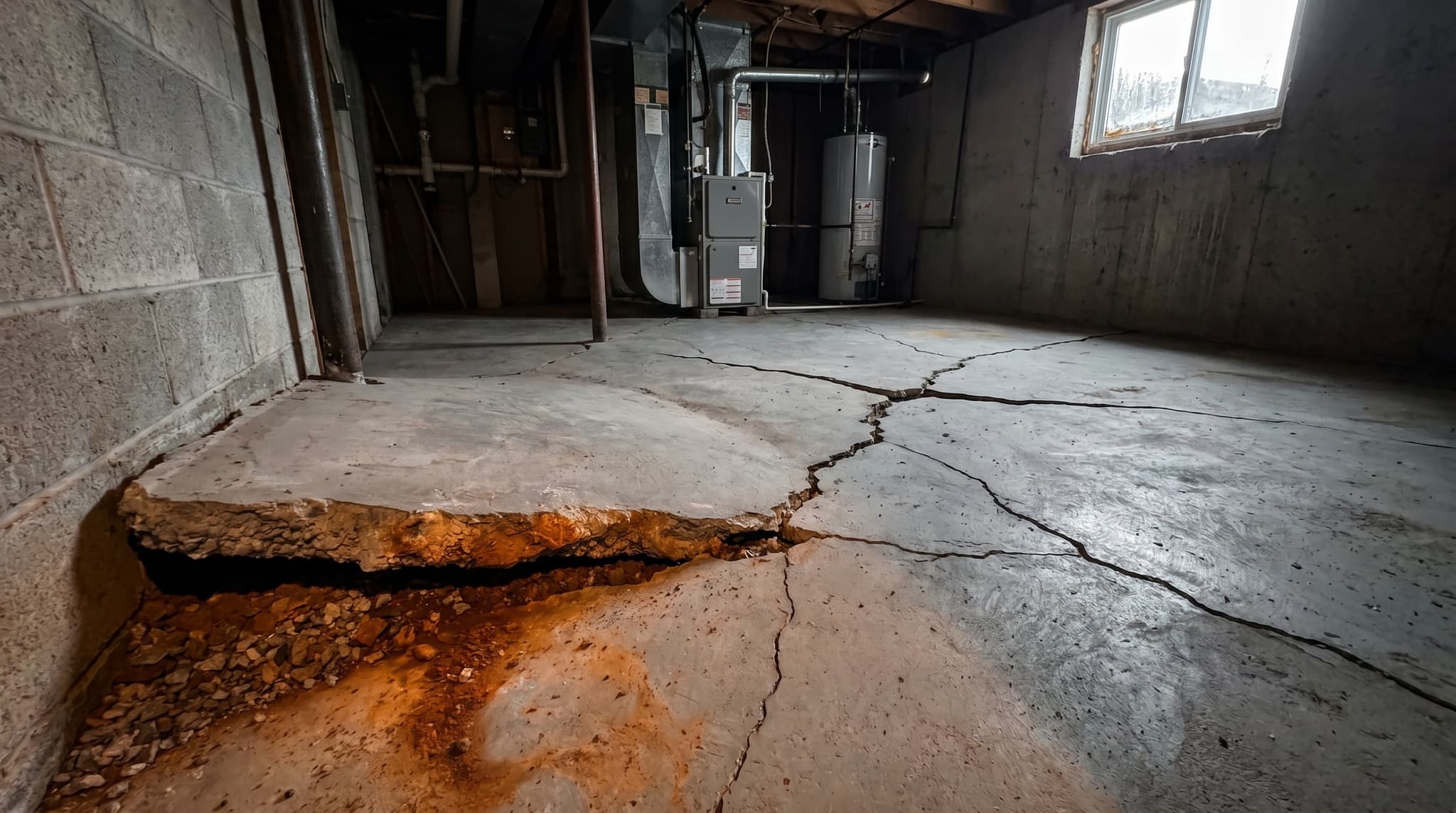
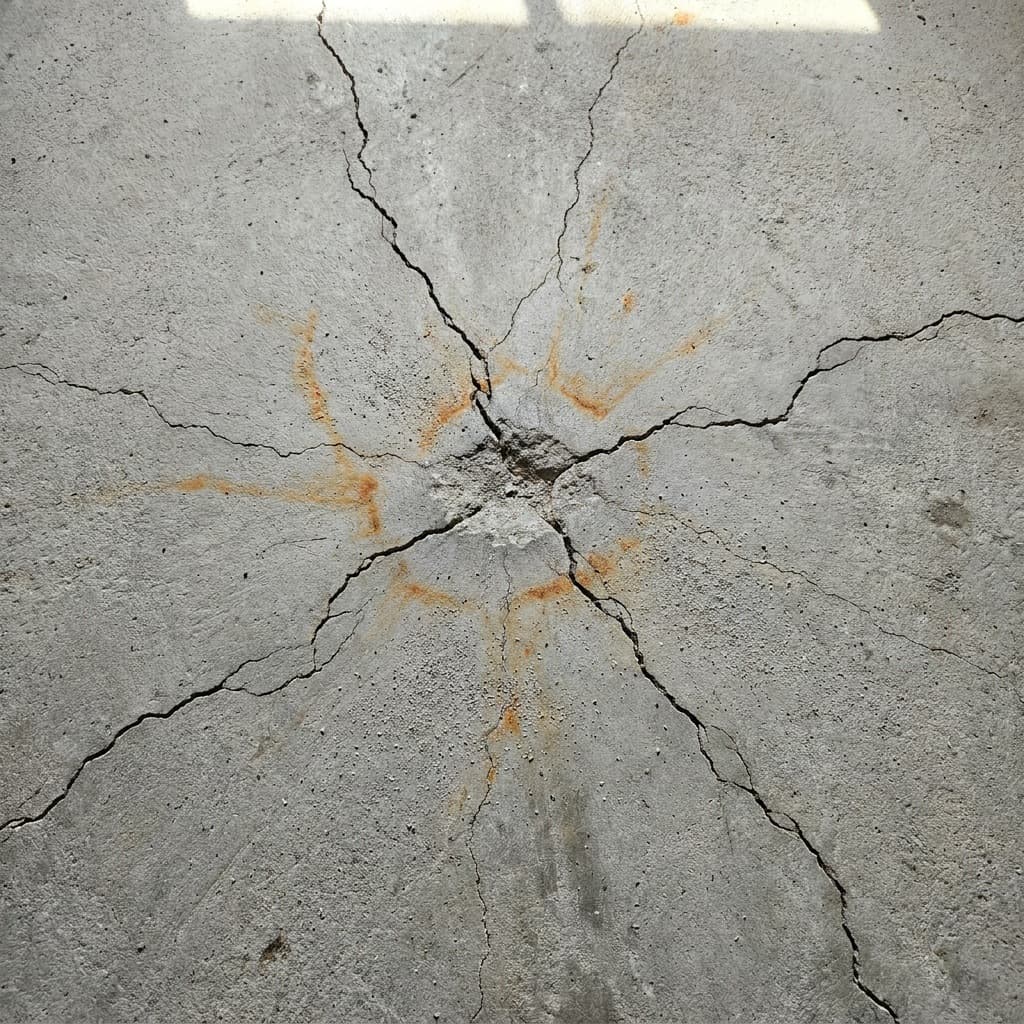
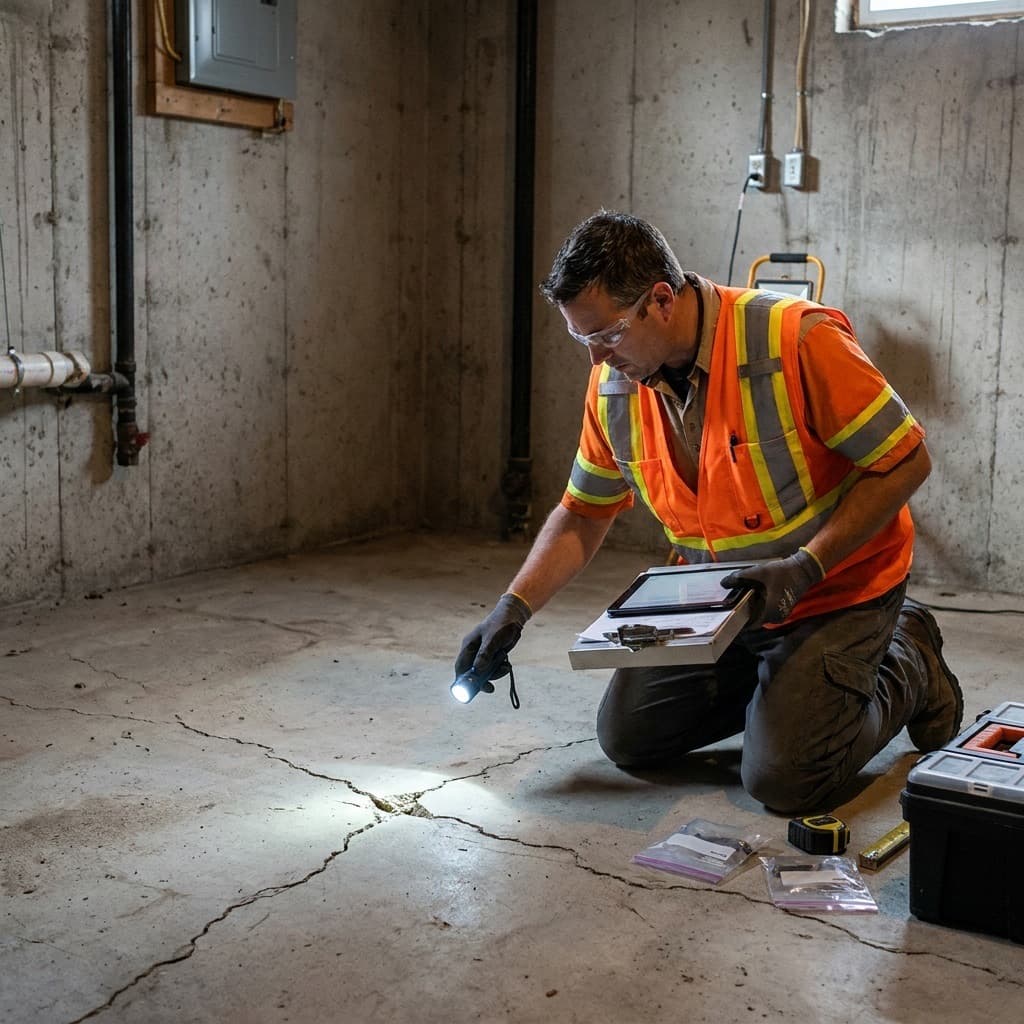
Five visible signs let a homeowner suspect pyrite under the slab or around the foundation. First, star-pattern cracks at the centre of the basement slab — cracks radiating outward from a central point, rather than linear cracks associated with normal shrinkage. Second, visible lifting of the slab, anywhere from a few millimetres to several centimetres depending on how advanced the reaction is. Furniture leans, basement closet doors catch at the bottom, gaps appear between the slab and the walls.
Third, horizontal cracks in foundation walls at footing level, often with a slight inward displacement. Fourth, interior basement partitions that warp, door frames that lose square, baseboards that pull away. Fifth, on an exposed slab (heated garage, unfinished basement), a whitish or yellowish deposit on the surface and around cracks — the sulphate efflorescence that accompanies the oxidation reaction.
None of these signs taken alone proves pyrite is present. A shrinkage crack, differential settlement or a drainage defect can produce similar symptoms. The diagnosis is only confirmed by a laboratory test on a sample taken from the backfill under the slab — the CTQ-M-200 test, named after the standardized Quebec protocol. If you notice two or more signs, or a single severe sign, request a professional diagnosis promptly: the more advanced the reaction, the heavier the intervention.
Why it happens — the chemistry in plain language
Three elements must be present for the pyrite reaction to start and continue: pyritic backfill (crushed stone rich in iron sulphide), water (soil moisture, water infiltration, condensation under the slab) and oxygen (present in the voids of the backfill, especially in a poorly compacted fill). When those three conditions come together, the pyrite oxidizes and gradually converts to gypsum. Gypsum occupies a noticeably larger volume than the original pyrite. That volume gain — the swelling of the backfill — pushes the slab upward and the foundation walls outward.
Why are some homes affected and not others on the same street? It all comes down to the source of the backfill used at construction. Two neighbouring homes built the same year by the same builder may have received crushed stone from different quarries — one rich in pyrite, the other not. That is why the laboratory test is essential: it objectively measures the sulphur content of the backfill sampled at your home, regardless of what is happening next door.
The standardized Quebec pyrite test is the CTQ-M-200 procedure, developed by the Quebec Pyrite Technical Committee. It combines a petrographic examination of the sample (visual identification of pyrite and associated minerals) and a measurement of sulphur content. The result is expressed as the Petrographic Pyrite Index (PPI) which classifies the swelling potential of the backfill. The higher the PPI, the greater the risk of reaction. The test is run by an accredited laboratory; we handle the sampling and shipping, and we provide you with the official report.
The real cost of doing nothing
Ignoring pyrite is the most expensive mistake a homeowner can make. The reaction does not stop on its own as long as the three conditions — pyrite, water, oxygen — are present. The longer you wait, the more the slab lifts, the wider the cracks, the more the walls deform, and the more the final repair costs. An intervention at an early stage — a few cracks, lifting of a few millimetres — is still heavy but manageable. At an advanced stage, where the slab is severely deformed and walls are pushed, you are looking at a major structural repair running into the tens of thousands.
The impact on home value is direct and significant. A home with a confirmed pyrite problem loses a meaningful share of its market value, and the sale becomes harder: informed buyers ask for a price reduction, their lender may refuse to finance without a repair report, and the pre-purchase inspection generally reveals the symptoms. In Quebec, undisclosed pyrite is a classic source of hidden-defect (vice caché) claims: if a buyer discovers the problem within three years of the sale and demonstrates that the defect existed, was serious, not apparent and not disclosed, they can ask for a price reduction or rescission of the sale. Quebec case law is full of judgments in that direction.
The practical advice for affected homeowners is simple. If you suspect pyrite and plan to sell in the next few years, run the CTQ-M-200 test now. If the result is negative, you have a valuable document that reassures the buyer. If it is positive, you know where you stand and can plan the intervention. When buying a home in Mascouche, Terrebonne, Repentigny or another historically affected sector, require a pyrite test in your conditional offer: the cost of the test is negligible compared with the risk of discovering the problem six months after taking possession.
False solutions to avoid
Three shortcuts circulate about pyrite and give the illusion of saving money that ends up costing far more later. First false solution, patching the slab or filling the cracks without treating the cause. The repair concrete holds for a few months, sometimes a year or two, then the crack returns in the exact same spot because the backfill keeps swelling underneath. That is money thrown away.
Second false solution, waiting for the reaction to stop on its own. Pyrite does not exhaust itself like a tank that empties. As long as unoxidized iron sulphide remains in the backfill and water and oxygen reach it, the reaction continues. On a backfill heavily loaded with pyrite, the swelling can stretch over 20 to 30 years before slowing, at a pace that easily outruns your sale or retirement horizon.
Third false solution, asking the original home builder for warranty. Even when the builder still exists and acknowledges the defect, the warranty on a residential building generally no longer covers pyrite once the legal delays have run, especially on homes over 10 to 15 years old. The hidden-defect claim against the home seller remains the main legal route — not a builder's warranty. Consult a real estate lawyer if you are in a claim situation.
The right solution according to GSV
The only durable repair for a pyrite problem is to remove the contaminated pyritic backfill under the slab and replace it with sound material — certified crushed stone with low sulphur content, conforming to the standard. It is a heavy job, but it is the only one that addresses the cause at the source and lets you put the home back on the market without a buyer warning clause.
The typical project runs in four stages. First, the demolition of the existing slab: cutting the concrete with a diamond saw, removing the pieces, exposing the pyritic backfill. Second, excavating the contaminated backfill to the depth recommended by the laboratory report — generally the full backfill under the slab, plus a margin around the footings if the reaction has already reached them. The pyritic backfill is hauled to an appropriate disposal site.
Third stage, laying the new backfill. The imported crushed stone is certified low-sulphur, compliant with the Bureau de normalisation du Québec requirements, delivered with a certificate of provenance that you keep. The backfill is compacted in successive lifts per the engineering spec. A polyethylene vapour barrier is laid over it before the pour to limit moisture migration toward the slab. Fourth stage, pouring the new concrete slab, with the thickness, reinforcement mesh and finish called for by the spec. The project typically runs from a few days to two weeks depending on the area treated and access.
Imperméabilisation GSV pairs this intervention with a full review of perimeter drainage when needed — French drain repair or replacement, foundation waterproofing redo, treatment of shrinkage cracks on the walls. The goal is to remove every source of water that was feeding the reaction and to make sure the new backfill stays in conditions where the reaction cannot restart, even if a trace of residual pyrite remains.
How much does pyrite treatment cost?
The cost of a pyrite intervention depends on several factors: the slab area to redo, the depth of backfill to excavate, basement access (stairs, garage door, enlarged window), the state of the foundation walls and drain, and the level of finish you want once the new slab is poured. Here are the ranges we regularly see in Lanaudière, as a guide only — only an on-site diagnosis gives you the precise number for your home.
The CTQ-M-200 pyrite test itself, sampling included, is the most modest investment of the process — in the few hundred dollars range. It is the unavoidable first step: no serious intervention should be planned without a lab report backing it.
Full backfill replacement under the slab of a typical residential basement is a significant five-figure investment — variable with area, excavation depth and access. On a typical two-storey home in Mascouche or Terrebonne, the full intervention with new slab pour, drain treatment and foundation waterproofing redo can be a major outlay. To that you often need to add the basement finishing (partitions, flooring, baseboards) if the basement was lived-in before the work.
That investment is almost always lower than the discount a buyer will apply to a home with declared untreated pyrite, and well below the risk of a successful hidden-defect claim. We always provide a detailed written estimate after the on-site diagnosis and the return of the lab report, free of charge, with no obligation.
Our process at Imperméabilisation GSV
Our approach to a pyrite file always follows the same steps. Step one, on-site visual diagnosis. Our team comes out, examines the slab, the foundation walls and the drainage, measures the lifting and the cracks, and establishes the probability of a pyrite problem. If the clues point that way, we recommend the laboratory test.
Step two, sampling and CTQ-M-200 test. We open the slab at the minimum needed (typically a small localized opening), take a representative sample of the backfill and ship it to an accredited laboratory in Quebec. The report comes back in a few weeks with the Petrographic Pyrite Index (PPI), the measured sulphur content and an interpretation. We hand you the original.
Step three, the intervention plan. Based on the lab report and the visual diagnosis, we walk you through the options that apply — from periodic monitoring if the PPI is low and the reaction still mild, all the way to full backfill replacement if the situation calls for it. You receive a detailed written estimate. No work begins until you formally accept.
Step four, the project and the warranty. Our crew handles the excavation, backfill replacement with certified stone, new slab pour and all the associated work on the drain and waterproofing. The job is documented with before-and-after photos. The certificate of provenance for the new stone is handed to you, and the whole project is covered by a written warranty. Imperméabilisation GSV is RBQ certified (licence 5596-4496-01), APCHQ, RECQ, Réno-Maître and Delta-MS — all credentials verifiable online.
Service areas
Imperméabilisation GSV handles pyrite problems throughout Lanaudière, the Laurentides and the North Shore of Montreal. We regularly travel to Mascouche — historically the most affected sector in the region — Terrebonne, Repentigny, Charlemagne, L'Assomption, Joliette, Saint-Charles-Borromée, Lavaltrie, Saint-Paul and surrounding municipalities. For urgent diagnoses before a real estate transaction, we prioritize visits as our schedule allows.
Suspect pyrite? Get the right diagnosis
Suspect a pyrite problem in Mascouche, Terrebonne, Repentigny, Charlemagne, L'Assomption, Joliette or anywhere else in Lanaudière? Imperméabilisation GSV comes out for the visual diagnosis, handles sampling and shipping to the accredited laboratory for the CTQ-M-200 test, and walks you through the options that apply to your case with a free written estimate. Over 30 years of experience, a local team based in Saint-Paul, RBQ licence 5596-4496-01, and current APCHQ, RECQ, Réno-Maître and Delta-MS certifications. Call 514.909.1422 — typically same-business-day response.
Why choose Imperméabilisation GSV?
- Over 30 years of experience
- Free, no-obligation estimate
- RBQ Licence: 5596-4496-01
- APCHQ, RECQ, Réno-Maître certified
- Warranty on all work
Frequently asked questions
Need a free quote?
Fast, professional service in Lanaudière, Laurentides, and Rive-Nord