
Concrete efflorescence — diagnosis and solutions in Lanaudière
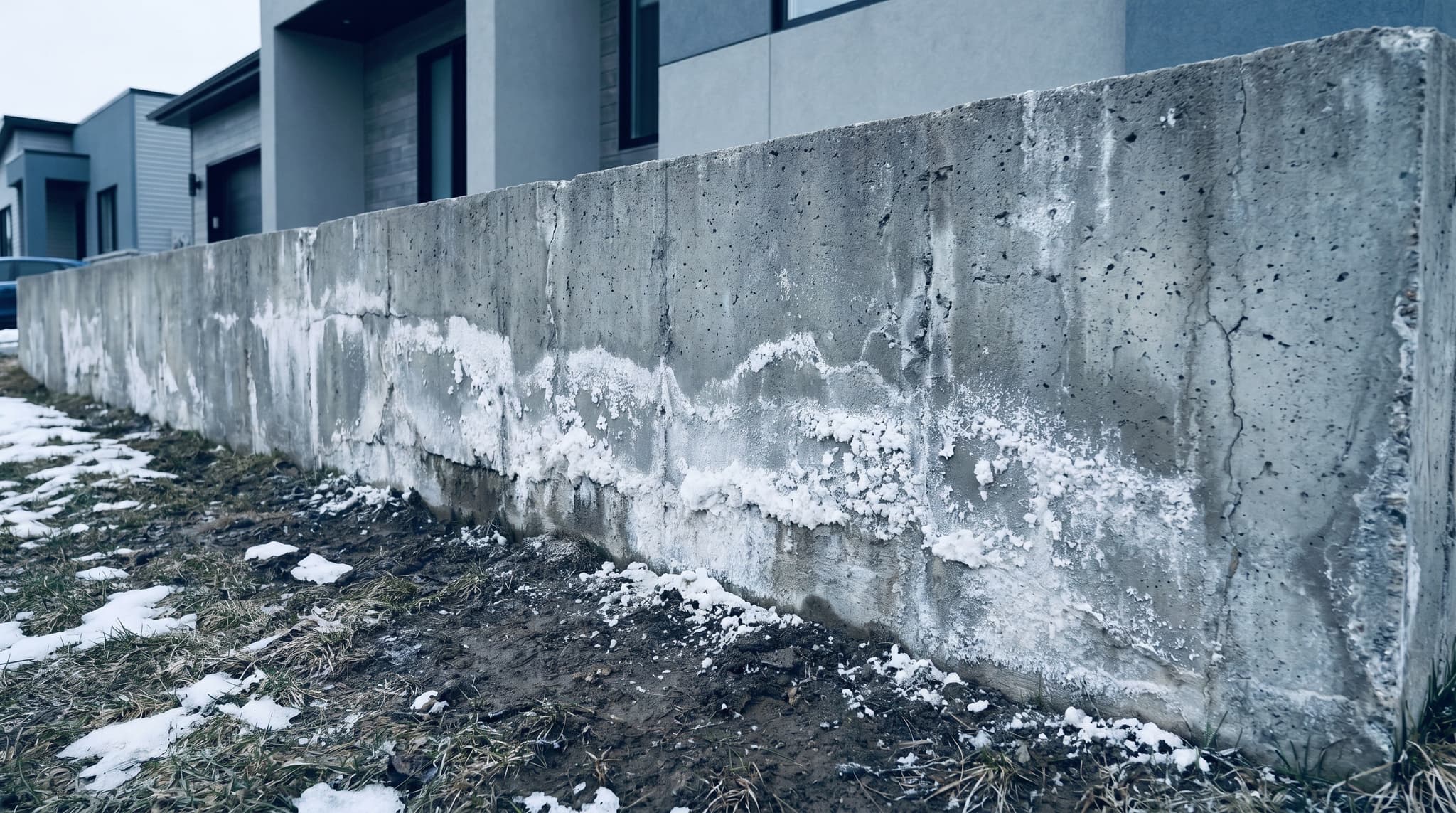
A powdery white deposit, sometimes in streaks, sometimes in diffuse blooms, showing up at the base of a foundation wall, on a basement block wall or on a concrete slab: that is what we call efflorescence — or, in everyday language, saltpetre. The deposit is rarely the real problem: it is the signal that moisture is migrating through the concrete, and the cause needs to be treated for the symptom to stop. Imperméabilisation GSV has been diagnosing and solving efflorescence problems across Lanaudière for over 30 years.
What is concrete efflorescence?
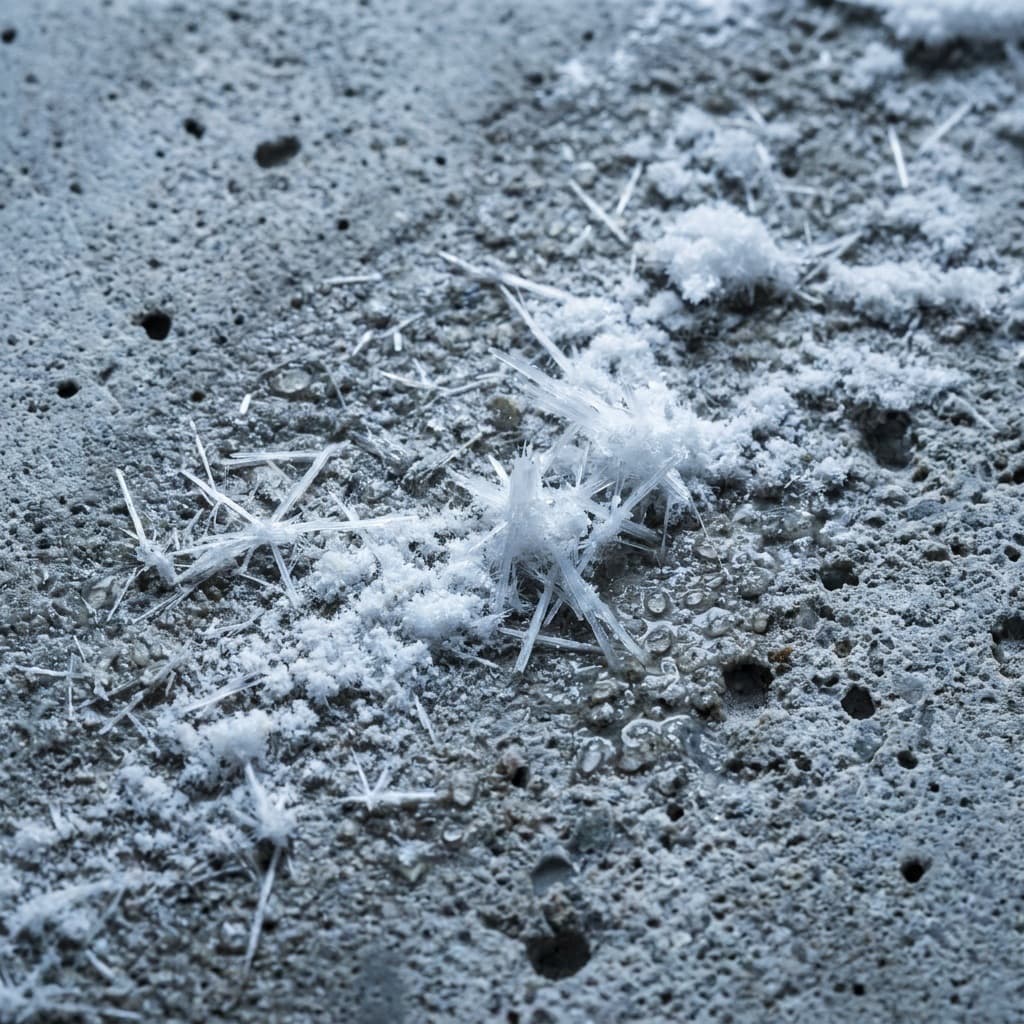
Efflorescence is a crystalline deposit formed by the migration of soluble salts through concrete, mortar or a block wall. The mechanism is simple: water travelling through the concrete matrix — soil moisture, infiltration, condensation — dissolves the mineral salts naturally present in the cement, the aggregates and the joints. When that water reaches the surface, it evaporates, and the salts it carried stay behind as visible white crystals. The crystalline deposit can be powdery and easy to brush off, or more stubborn, glassy, made of calcite (calcium carbonate) that adheres firmly to the surface.
Two main categories are usually distinguished. Primary efflorescence appears quickly after the concrete is placed — typically in the weeks or first months — and comes from free salts already present in the mix. It is often transient and may disappear after a few rain cycles. Secondary efflorescence, much more frequent on existing homes, appears later and signals chronic moisture migration through the concrete. That second form is the one that matters to the homeowner: it almost always indicates a waterproofing defect.
The popular term saltpetre refers to the same phenomenon, even though historically saltpetre meant specifically a deposit of potassium or calcium nitrate. On a modern foundation, the saltpetre you see is mainly calcium carbonate and various sulphates — all produced by water travelling through the concrete. The technical nuance does not change the conclusion: a wall that shows saltpetre is a wall that is letting water through, full stop.
How do I know it's efflorescence?
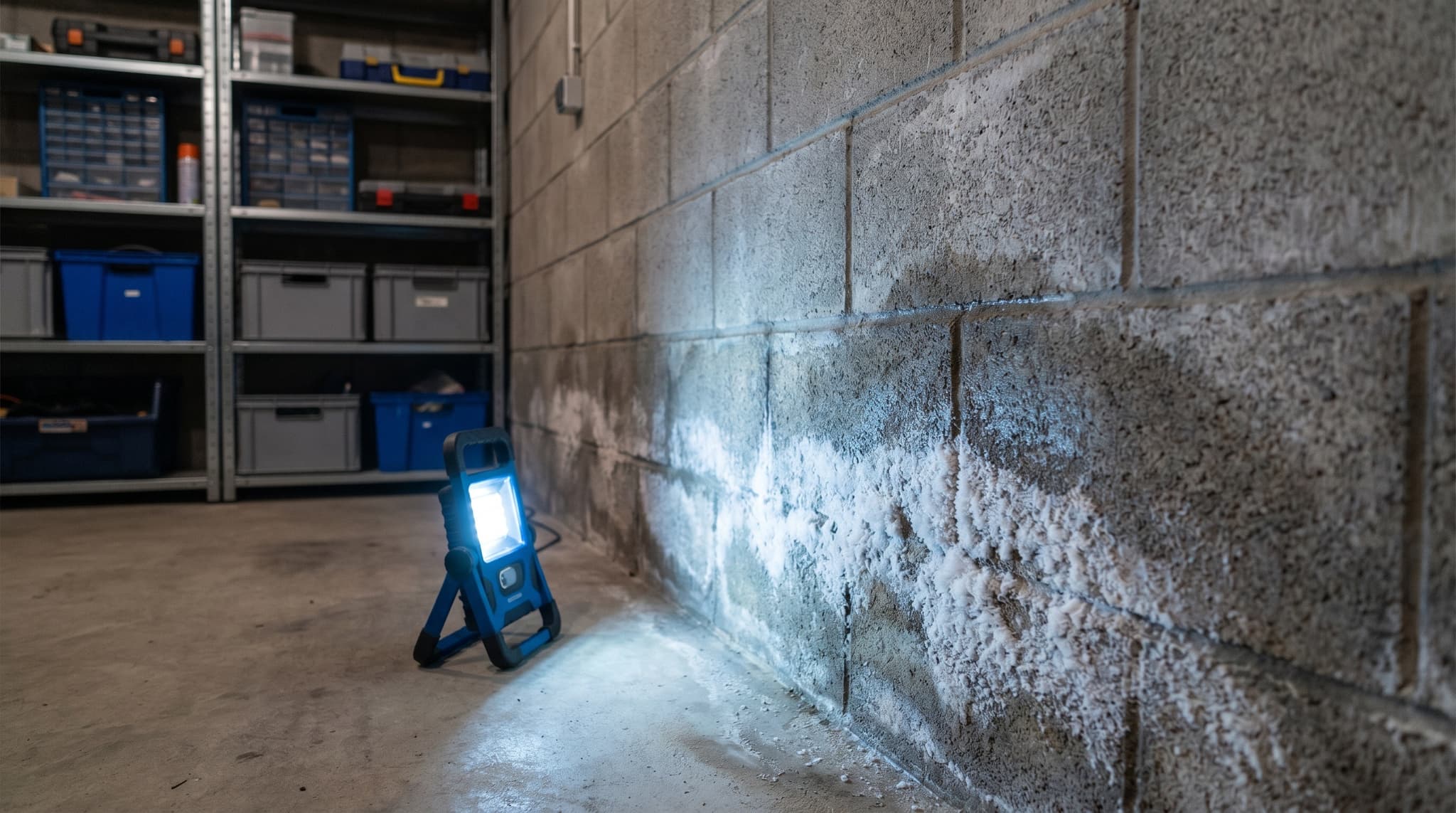
Three visible signs help distinguish efflorescence from other deposits. First, the location: efflorescence typically appears on concrete, mortar or block surfaces in contact with a moisture source — the base of a foundation wall, the soil-side of a basement wall, a garage slab, a retaining wall, the bottom of a brick chimney. Second, colour and texture: a white deposit, sometimes lightly gray or yellowish, powdery at first and becoming glassy or hard over time. Third, the simple water-drop test: pour a few drops of water on the deposit — if it dissolves and disappears momentarily, it is likely a soluble efflorescence (sulphates); if it stays intact but crumbles under friction, it is more likely a poorly soluble calcium carbonate.
Four signs often accompany efflorescence and help orient the diagnosis. Slight moisture to the touch on the wall, a damp smell, dark stains around the deposit, or bubbling or peeling paint nearby all indicate active moisture migration. If the deposit is old, already dried out and with no residual moisture around it, the problem may be historical — for instance tied to a single past infiltration that has since been corrected. A proper diagnosis tells the two apart.
A common confusion is with mould. Mould is usually black, green, sometimes pink or orange, and grows on organic materials (drywall, wood, paper). Efflorescence is white and forms on mineral materials (concrete, mortar, brick). If you are unsure, observe the colour and the substrate. Mould in the basement also indicates a moisture problem — but the treatment is different.
Why it happens — moisture migration
Three major routes account for almost every case of secondary efflorescence we see in the field. The first and most frequent, infiltration of groundwater from outside the foundation, which travels through the concrete or the blocks and releases its soluble salts at the inside surface. A defective French drain, a missing or degraded exterior waterproofing membrane, a reverse slope toward the house or downspouts dumping at the base of the wall are the classic causes.
Second route, capillary rise through the concrete. On footings and walls without a capillary break (modern techniques use a horizontal membrane or an anti-capillary additive in the slab), groundwater climbs through the microscopic pores of the concrete. It is typical of older homes where the original design did not provide for this protection. Efflorescence then often appears at chest height on the lower portion of the walls, well above outside grade.
Third route, internal condensation. In a cold, poorly ventilated basement, where warm humid air meets a cold concrete surface, water condenses on the surface and, over cycles, ends up dissolving the salts and forming efflorescence — especially on a wall that is already slightly damp. This route is less frequent than the first two but possible, particularly in homes where the basement was partially finished without proper vapour management.
Less often, water travelling through an unsealed slab-to-wall joint, a horizontal crack in a block foundation, or a poorly sealed basement window feeds a specific area and concentrates the efflorescence there. The on-site diagnosis identifies which route is involved: efflorescence forms exactly where the water lands, and observing the deposit's mapping — its intensity, its height, its pattern — already gives most of the answer.
The real cost of doing nothing
Efflorescence on its own is not a short-term structural risk. A white deposit on a basement wall does not mechanically downgrade the home. But the deposit is the symptom of an active cause — moisture migration — and that cause produces costly damage over the medium term. Concrete subjected to repeated wet-dry cycles gradually loses its surface strength: the cement paste breaks down, the aggregate frees itself, the wall crumbles (concrete spalling, a distinct but often correlated problem). On a block wall, mortar joints weaken and eventually disintegrate.
The second effect is health and comfort related. Chronic basement moisture supports mould growth on the surrounding organic materials — drywall, insulation, baseboards, furniture, cardboard boxes — and degrades indoor air quality. For occupants with asthma or allergies, the impact is fast and noticeable. The damp smell that settles in, that no air freshener really masks, also becomes a sign buyers spot immediately when the house goes to market.
The third impact is on market value. A foundation visibly blooming with efflorescence, especially when the bloom is old and widespread, lowers the sale price — not so much through the direct repair cost as through the impression of neglected maintenance it gives off. An informed buyer reads efflorescence as a red flag suggesting other possible problems outside. Treating the source now almost always costs less than the discount at sale time.
False solutions to avoid
Three approaches come up often and give the illusion of a fix that does not hold. First false solution, painting over the efflorescence without treating anything. Paint applied to a wall through which moisture is migrating bubbles, peels and detaches in sheets within months. Worse, some paints trap moisture and accelerate the degradation of the concrete behind them. A wall that shows saltpetre is not a wall you cover up; it is a wall you treat.
Second false solution, dry-brushing the deposit and walking away. Efflorescence comes off fairly easily with a dry brush or a stream of water, which produces a false sense of victory. The deposit returns in the following weeks or months because the moisture migration itself has not been corrected. Brushing is part of cleaning, but it solves nothing without source treatment.
Third false solution, applying an interior sealer or waterproofing primer alone, without correcting what is going on outside the foundation. A well-applied interior primer can indeed reduce moisture migration in some cases, but if there is active water pressure on the other side of the wall — defective drain, bad slope, misdirected downspout — the primer peels or punctures within a few years and the problem returns. Interior primer has its place as a finishing step, after the exterior source has been treated.
The right solution according to GSV
The general rule is clear: treat the source, not the symptom. That starts by precisely identifying where the water feeding the efflorescence is coming from. The on-site inspection combines observation of visible clues (deposit mapping, moisture stains, mould, bubbling paint, cracks), exterior inspection of the lot (slope, gutters, foundation cracks, window-well condition) and, when needed, a camera inspection of the French drain to confirm or rule out a compromised drain.
Depending on the identified origin, the solution differs. For infiltration through the outside of the foundation, a full redo of the exterior waterproofing — excavation, cleaning the wall, applying a new elastomeric membrane or installing a Delta-MS dimpled membrane, draining backfill — addresses the cause at the source. It is the most durable intervention. For a compromised French drain, high-pressure cleaning or drain replacement comes alongside.
For localized problems (horizontal crack, slab-to-wall joint, vertical crack), an interior polyurethane injection seals the water path through the full thickness of the wall. For capillary rise on an old foundation without a capillary break, chemical injection techniques at footing level can create a horizontal barrier that blocks vertical migration. For internal condensation, improving ventilation and installing a properly sized dehumidifier is part of the plan.
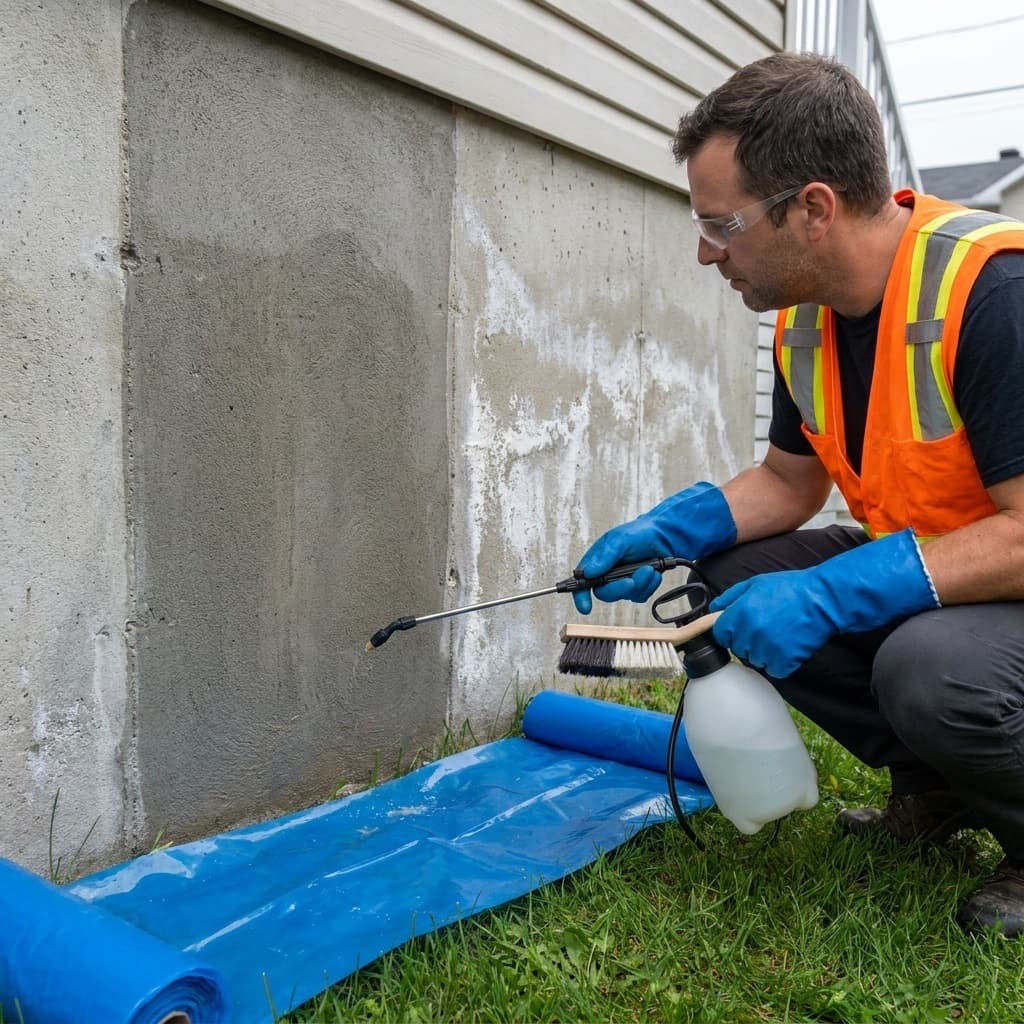
Once the source is treated, cleaning the existing deposit is a finishing step. Start with a mechanical dry-brushing to lift off as much of the powdery deposit as possible. For stubborn calcium carbonate deposits, a specialized acid cleaning — diluted muriatic acid or equivalent commercial products, applied with the required PPE, thoroughly rinsed — dissolves the resistant crystals. On walls where a finish is planned, a waterproofing primer applied on dry, clean concrete prepares the surface for paint or coating. On walls where cracks may still appear long-term, the primer can be paired with an interior elastomeric membrane that follows minor movement of the concrete without tearing.
How much does efflorescence treatment cost?
The cost depends directly on the cause identified at diagnosis and on the area to treat. Here are the ranges we regularly see in Lanaudière, as a guide only — every home is different and only an on-site diagnosis gives you an actual price.
The on-site inspection with visual diagnosis and written estimate is free, no obligation. The French drain camera inspection, when needed to confirm or rule out a compromised drain, runs a few hundred dollars. Specialized acid cleaning of an efflorescence-affected surface, followed by rinsing and drying, is a few hundred to a few thousand dollars depending on area.
For source treatment itself, the cost varies widely. Polyurethane injection on a foundation crack: a few hundred to about a thousand dollars per crack. High-pressure drain cleaning: one to three thousand dollars depending on length. Full exterior waterproofing redo by excavation, including backfill removal, wall cleaning, new membrane application and draining backfill: a five-figure investment, variable with length of wall, basement depth and site access. Applying an interior waterproofing primer after the exterior source has been corrected is the least expensive step, and it meaningfully extends the result.
We always provide a detailed written estimate after the on-site diagnosis, free of charge, with no obligation.
Our process at Imperméabilisation GSV
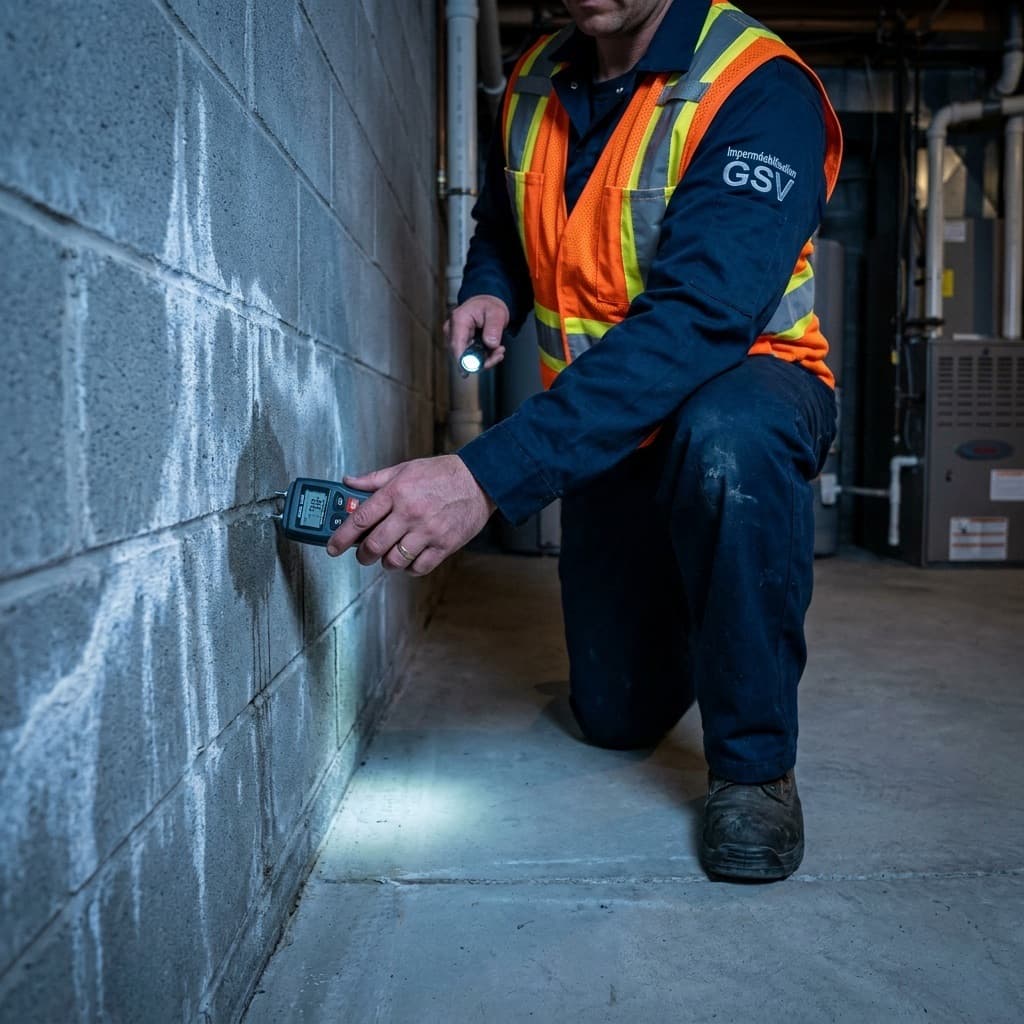
Our approach to an efflorescence file always follows the same logic: diagnose the source before intervening, do not just clean the symptom. Step one, on-site inspection. We observe the deposit's mapping, measure wall moisture with a moisture meter, inspect the outside of the foundation (slope, gutters, window wells, visible cracks) and, when needed, schedule a French drain camera inspection.
Step two, diagnosis and intervention plan. Based on the inspection, we walk you through the options that apply in plain language, with the strengths and limits of each. You receive a detailed written estimate, no obligation. When several interventions are defensible — for instance, a drain that would benefit from cleaning before heavier work, or a surface drainage correction that might be enough — we say so honestly rather than systematically pushing toward the heaviest job.
Step three, the work. According to the chosen plan, our crews carry out the source treatment (crack injection, drain cleaning or replacement, exterior waterproofing redo, surface drainage correction) then, if applicable, the cleaning of the deposit and the application of an interior waterproofing primer. The job is documented with before-and-after photos.
Step four, warranty and follow-up. All our interventions are covered by a written warranty handed to the customer. We remain available to answer questions in the months that follow. Imperméabilisation GSV is RBQ certified (licence 5596-4496-01), APCHQ, RECQ, Réno-Maître and Delta-MS — all credentials verifiable online.
Service areas
Imperméabilisation GSV handles efflorescence and saltpetre problems throughout Lanaudière, the Laurentides and the North Shore of Montreal. We regularly travel to Joliette, Saint-Charles-Borromée, Notre-Dame-des-Prairies, Repentigny, Mascouche, Terrebonne, Lavaltrie, L'Assomption, Saint-Paul and surrounding municipalities.
White deposits on your foundation? Call us
Seeing saltpetre or efflorescence at the base of a foundation wall, a basement wall or a concrete slab in Joliette, Repentigny, Terrebonne, Mascouche, Lavaltrie or anywhere else in Lanaudière? Imperméabilisation GSV comes out for an on-site diagnosis, identifies the exact source of moisture migration and provides a free written estimate of the applicable solutions. Over 30 years of experience, a local team based in Saint-Paul, RBQ licence 5596-4496-01, and current APCHQ, RECQ, Réno-Maître and Delta-MS certifications. Call 514.909.1422 — typically same-business-day response.
Why choose Imperméabilisation GSV?
- Over 30 years of experience
- Free, no-obligation estimate
- RBQ Licence: 5596-4496-01
- APCHQ, RECQ, Réno-Maître certified
- Warranty on all work
Frequently asked questions
Need a free quote?
Fast, professional service in Lanaudière, Laurentides, and Rive-Nord