
Frost heave of a foundation — diagnosis and solutions in Lanaudière
When a foundation, a basement slab or an exterior step rises in winter and drops back (sometimes only partially) in spring, it is not a quirk of the building: it is frost acting on a frost-susceptible soil. In Quebec, the freezing ground can generate enormous pressures and shift concrete elements by several centimetres. Imperméabilisation GSV has been diagnosing the exact origin of frost heave and installing the right solutions across Lanaudière for over 30 years.
What is frost heave?
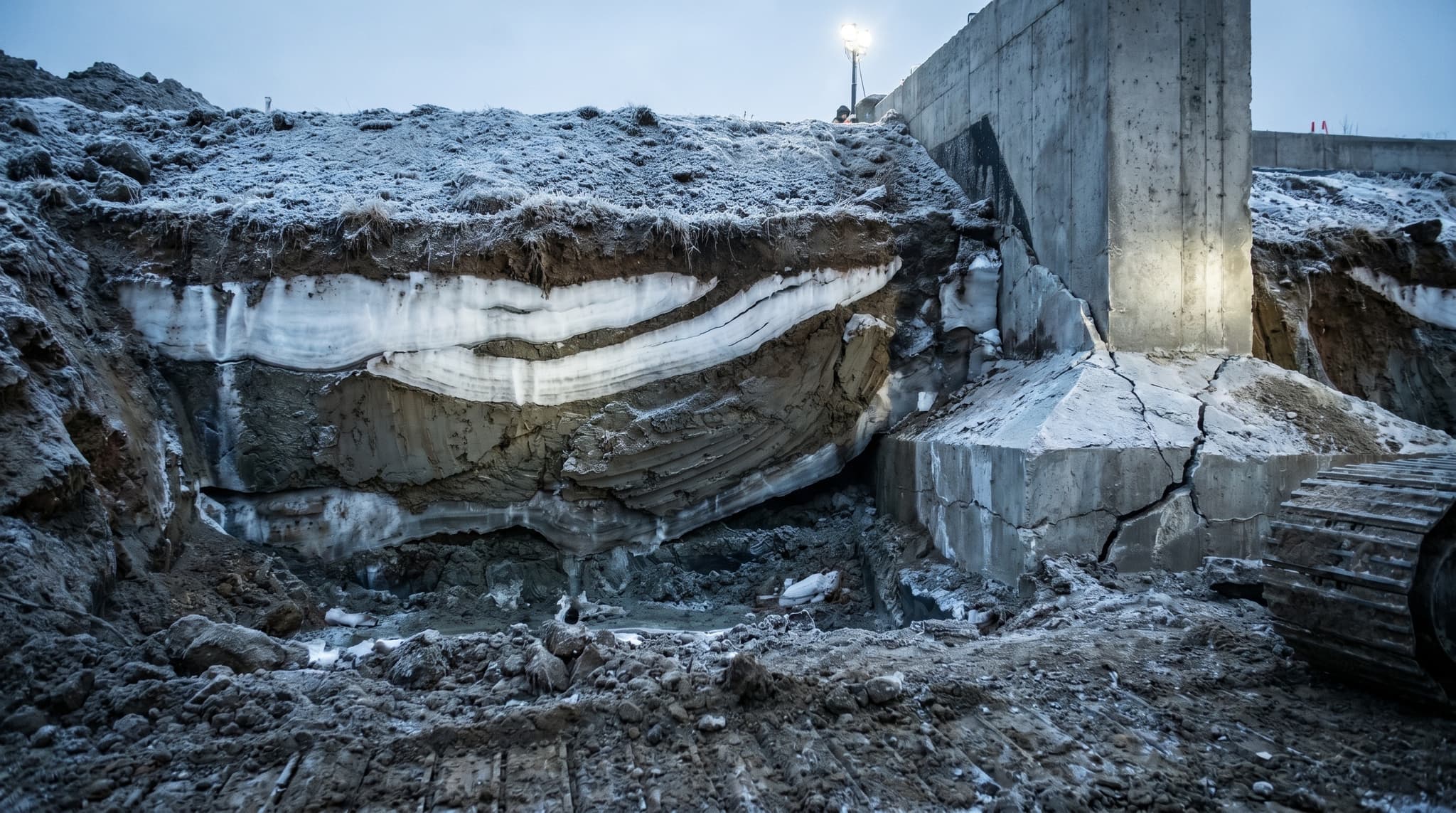
Frost heave, or soil heaving from frost, is the upward vertical displacement of an element sitting on freezing ground. The mechanism is not simply the freezing of pore water: it is mainly explained by the formation of ice lenses in the soil. As the frost front descends slowly, water still liquid below is drawn by capillarity toward the freezing layer, building horizontal sheets of ice — the lenses — whose volume far exceeds simple thermal expansion. These lenses can lift whatever sits above them with considerable force.
Three conditions need to be met for meaningful heave: a frost-susceptible soil (clay or silty soil capable of drawing water by capillarity), an accessible water source, and frost that reaches deep enough to engage the susceptible soil. Quebec ticks all three boxes: the St. Lawrence Lowlands clays are highly frost-susceptible, high water tables are common in Lanaudière, and our winters drive the frost front down to 1.2 metres or more depending on the area and the season.
That is why the Quebec construction code requires foundation footings to be placed below the frost line — generally at least 1.2 metres below finished grade in Lanaudière, sometimes more. When that rule is met and the soil under the footing is not frost-susceptible, the foundation is protected. When it is not — older construction, an addition done without permit, an exterior step or stoop placed at the surface — frost heave becomes possible.
How do you know if you have this problem?
Several signs make frost heave recognizable. First and most visible: a seasonal vertical displacement of a building element. A basement door that rubs in winter and opens normally in spring, a horizontal crack that opens and closes, a stoop that rises a few centimetres then drops back, an exterior step that goes out of alignment — all signal that something is moving with the seasons.
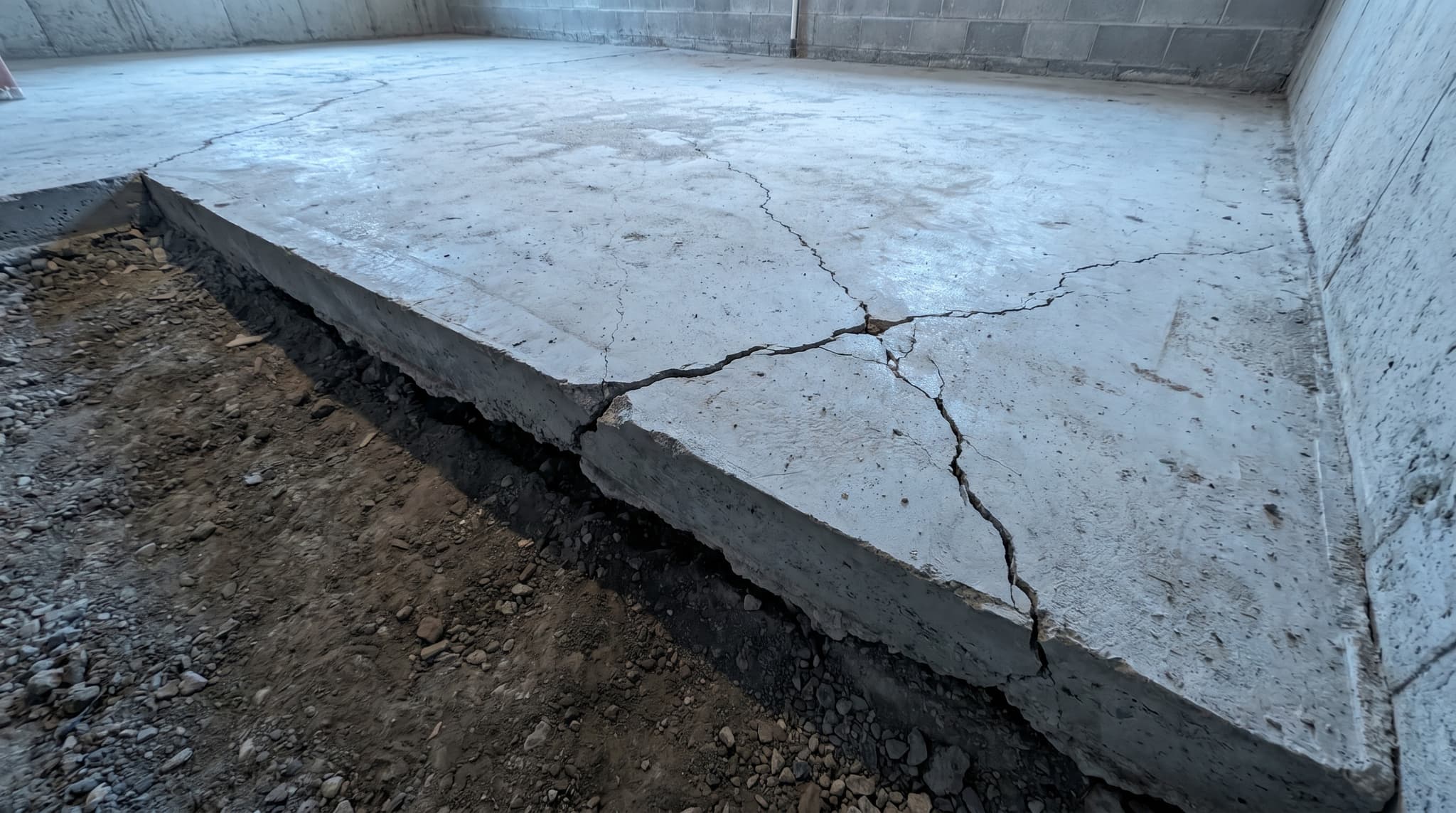
Second sign, a displaced or centrally cracked basement slab. When the soil under the slab is frost-susceptible and water migrates into it, the slab can lift, develop a radial or star-shaped crack, then settle back incompletely on thaw. On uninsulated slabs, particularly in older basements built without under-slab insulation, this is something we see regularly.
Third sign, cracks appearing in unusual places: at the joint between an addition and the main body of the house (the addition moves differently from the original), at the junction of a stoop and the foundation wall, or at the top of a foundation wall pulling slightly away from the framing above. Fourth sign, on exterior steps and stoops: misaligned steps in winter, tilting backward or forward, cracks at the wall connection. That is where frost heave is most common because these elements are almost always placed at the surface, directly exposed to frost.
When should you call in a professional? As soon as a seasonal movement repeats, or when the amplitude of the heave grows year over year. A worsening heave often signals that the soil's thermal insulation — natural (snow cover) or artificial (perimeter insulation) — has lost effectiveness, or that the perimeter drainage has degraded. An early assessment often allows intervention before structural damage accumulates.
Why does it happen?
Several causes can explain frost heave, and they often combine. First cause, a footing placed too high, above the frost line. Typical of older construction (pre-modern code), some additions done without permit, and almost all surface-placed exterior steps and stoops. The frost-susceptible soil under the footing freezes, expands, and lifts the element.
Second cause, a particularly reactive frost-susceptible clay soil. Not all soils are equal: clean sand is non-susceptible (water drains too fast to form lenses), while a silty clay, of the kind found across much of Lanaudière, is highly susceptible. The same frost depth in two different soils produces very different heave.
Third cause, a failing perimeter drainage. When water accumulates around the foundation instead of being carried off by the French drain, the soil stays saturated, which significantly amplifies ice-lens formation. A drain blocked by iron ochre, an absent drain, or surface drainage that channels water toward the house rather than away are typical aggravators.
Fourth cause, absence of perimeter insulation. Horizontal buried insulation around a shallow foundation (often called a frost skirt) keeps the frost front away from the footing. Without it, on a shallow foundation, frost reaches the soil under the footing directly. Fifth cause, variation in snow cover: a stripe systematically cleared at the base of the wall (snow blower, aggressive de-icing) deprives the foundation of the natural insulation that snow provides, and frost penetrates deeper at that exact location.
The real cost of doing nothing
Untreated frost heave produces cumulative damage. Every freeze-thaw cycle adds a bit of displacement, works existing cracks open and shut, and eventually compromises the foundation's watertightness. Cracks that open and close with the seasons are preferential paths for water in the spring, eventually producing basement water infiltration — a secondary problem that often costs more to fix than the heave itself.
On exterior steps and stoops, repeated heave eventually misaligns the treads to the point of becoming a fall hazard. On a lifted basement slab, the movement can disrupt partitions and interior finishes, and complicate basement finishing. On a main foundation, the consequences can reach the building's structure: a door that no longer closes, cracks in upstairs plaster, a tilting floor.
On home value, an active and visible heave discourages buyers and almost always triggers a request for correction at the pre-purchase inspection. Hidden-defect claims remain possible when a chronic heave was not disclosed and ultimately aggravates an infiltration discovered after the sale. A documented early intervention by a certified contractor protects property value and meaningfully limits legal risk.
False solutions to avoid
Three approaches are tried regularly and bring little to no result. First false solution, simply rebuild the heaved element without addressing the cause. Rebuilding a stoop that heaves every winter, on the same soil, without improved insulation and drainage, guarantees the same job again in five years. Diagnosis must always precede rebuilding.
Second false solution, inject resin or polyurethane into seasonal cracks without addressing the movement. Polyurethane injection is an excellent treatment for stable cracks, but a crack that opens and closes every year because of frost heave will tear the seal at the next cycle. The movement has to be stabilized first, then residual cracks treated.
Third false solution, add mass to the heaved element hoping it resists frost. Frost generates pressures that almost always exceed the useful load of a residential stoop or step; adding weight just produces a heavier object that still heaves. The correct strategy is to prevent frost from acting on the footing rather than trying to counter it mechanically.
The right solution at GSV
The correct strategy combines, depending on the case, several of the following interventions. First possible intervention, lower the footing below the frost line. When an element (stoop, step, addition) sits too high, the durable solution is to excavate around it, build a deeper footing — generally at least 1.2 metres depending on the area — and rebuild the element on that new base. It is the most definitive intervention because it eliminates the cause at the source.
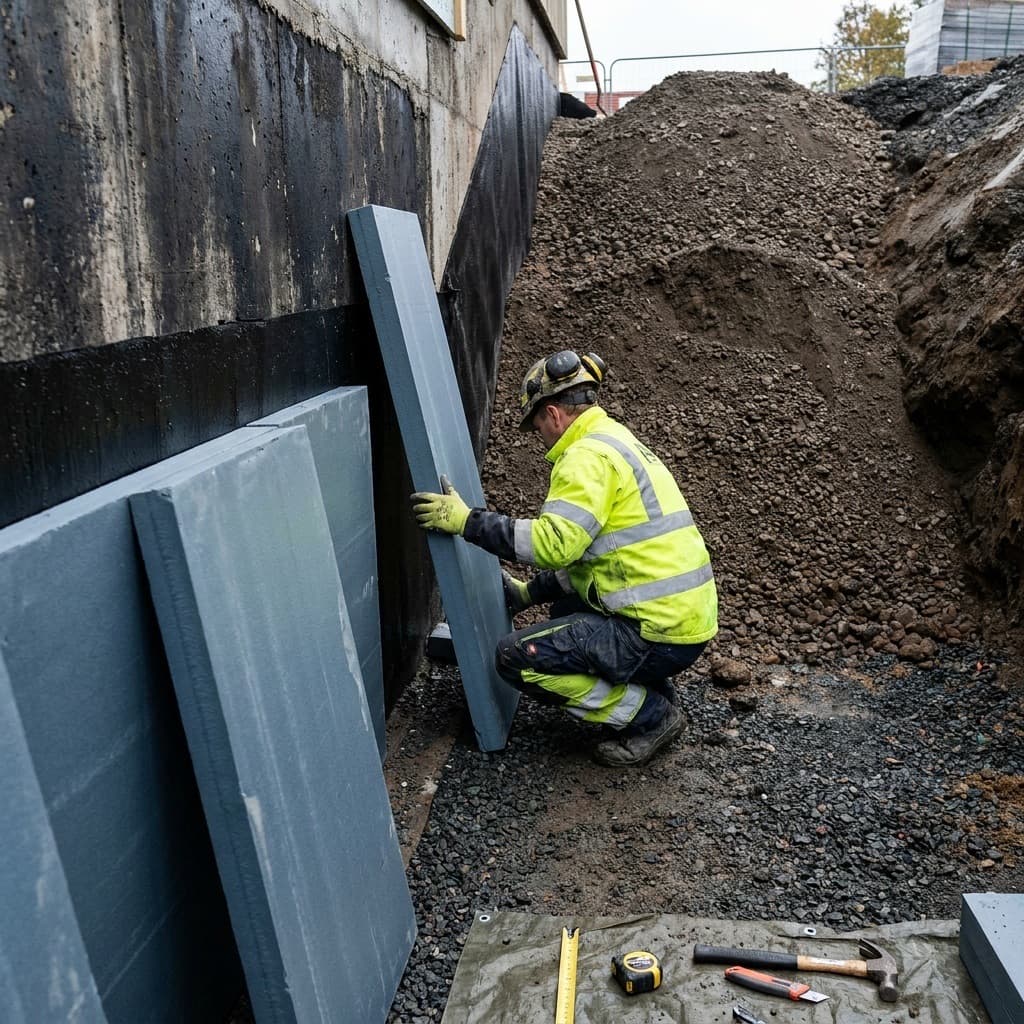
Second possible intervention, buried perimeter insulation. On a shallow foundation that cannot be lowered, a rigid insulation skirt (typically high-density extruded polystyrene panels) is installed horizontally a few feet out from the foundation, at about 30 to 50 cm below the surface. The skirt keeps the frost front away from the footing and works especially well on stoops, verandas and partially buried foundations.
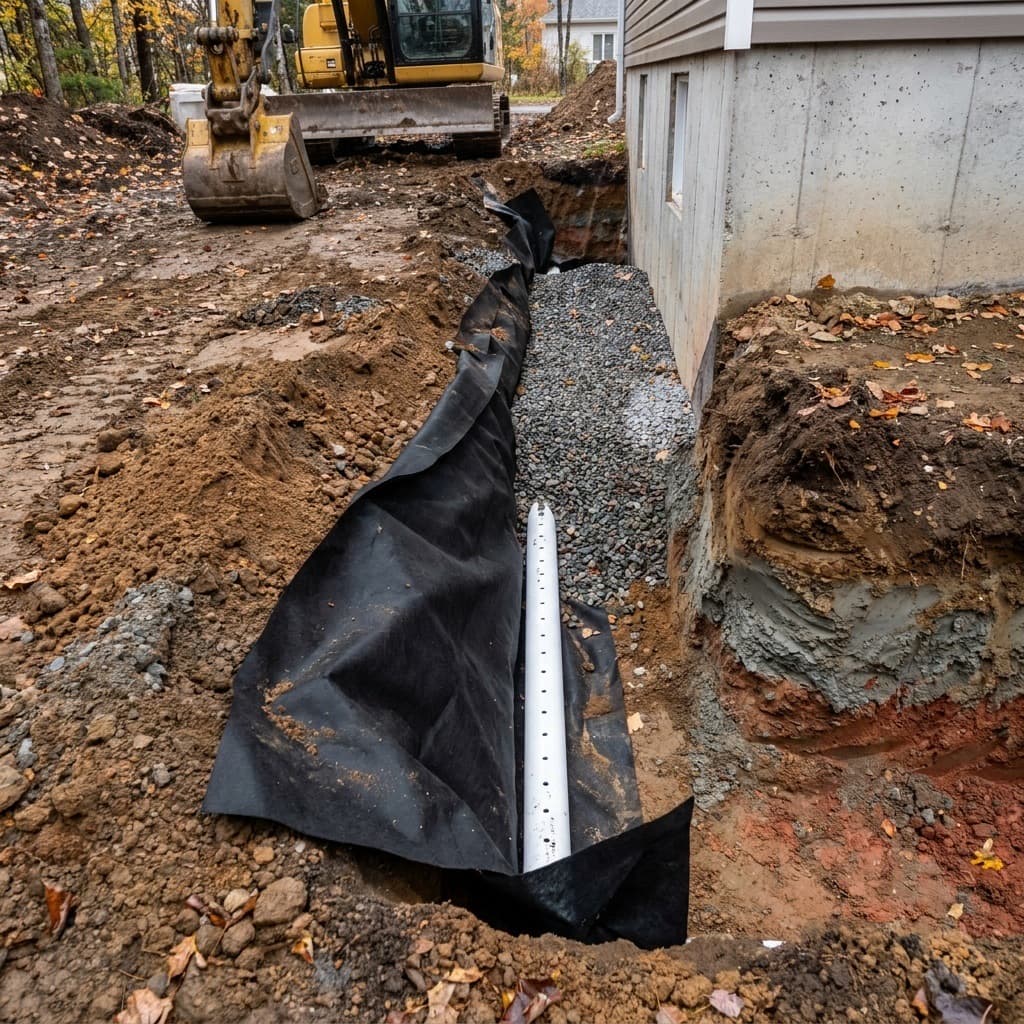
Third possible intervention, rework the perimeter drainage. A healthy French drain carries water away from the foundation, sharply reducing ice-lens formation. If a camera inspection reveals a blocked, crushed or absent drain, its cleaning or replacement is part of the solution. See our French drain installation page for the technical detail of a replacement.
Fourth possible intervention, surface drainage. Ground regraded to direct water away from the foundation, downspouts extended at least 1.5 metres, removal of concrete pads that hold water against the wall, basement windows fitted with draining window wells. These simple corrections reduce saturation of the perimeter soil and, as a result, the amplitude of seasonal heave.
On main foundations, these interventions are often combined with a redo of the exterior waterproofing, because the perimeter excavation needed to install insulation or rework drainage is also the right moment to lay a new membrane against the foundation wall. See our foundation waterproofing page for this type of combined project.
How much does the treatment cost?
The price depends on the type of heaved element, the depth of excavation, site access and the interventions to combine. Here are the ranges we regularly see in Lanaudière, as a guide only — every case is assessed on site.
Rebuilding a stoop or exterior step with a new footing below the frost line: a medium intervention, a few days on site, the amount varying with size. Installing a perimeter insulation skirt around a shallow foundation: a scalable intervention, with a price that depends on the linear length and the depth of excavation. Reworking the perimeter drainage with excavation, drain replacement and new waterproofing: a five-figure investment, often combined with perimeter insulation as a single project.
Structural rework of a heaved main foundation: a larger investment that can require temporary shoring, micropiles or underpinning depending on an engineer's diagnosis. We always provide a detailed written estimate after the on-site inspection, free of charge, and we coordinate with a structural engineer when the situation requires it.
Our process
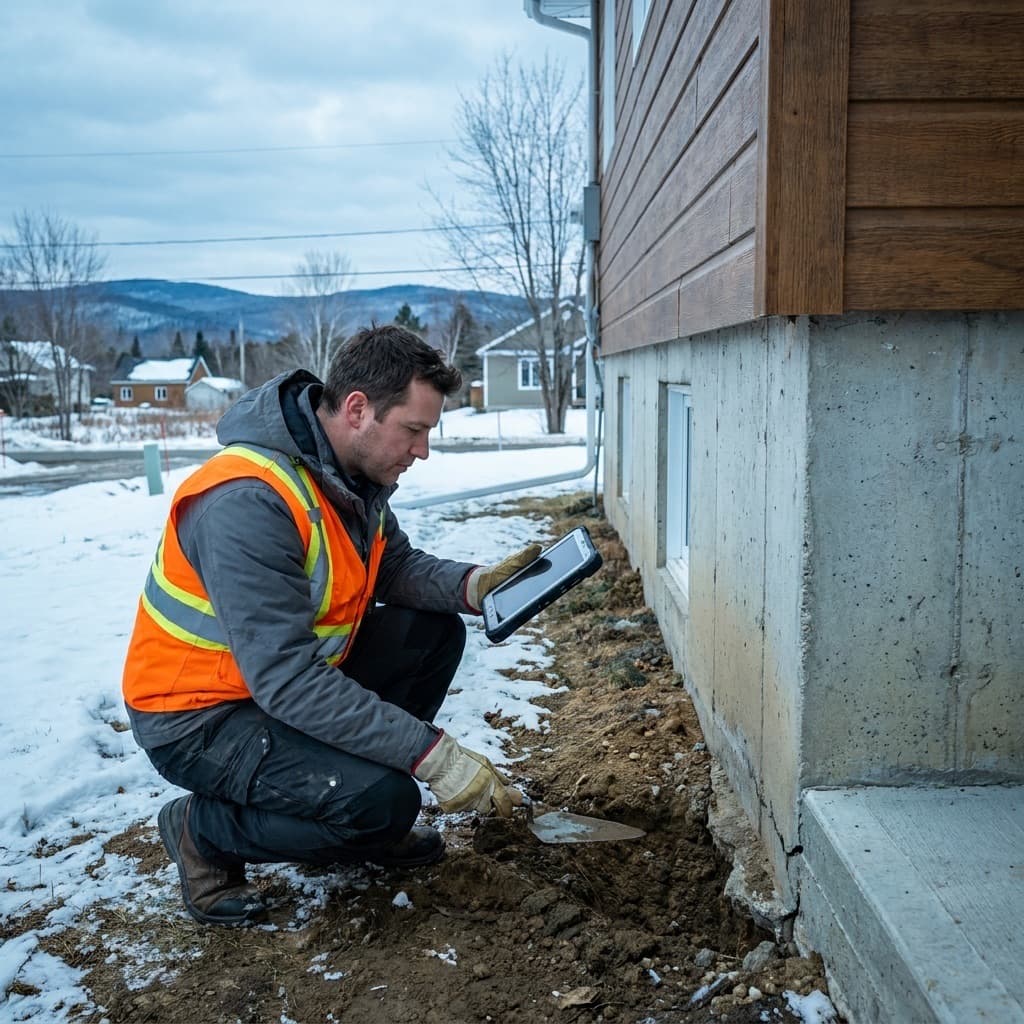
Our approach to frost heave follows four steps. Step one, the on-site inspection. We assess the heaved element, measure the amplitude of the displacement (where possible against a stable reference), examine the perimeter drainage, check the estimated footing depth, and identify the soil. When the structural cause is not obvious, we coordinate a partial diagnostic excavation to observe the footing directly.
Step two, the intervention plan. Based on the diagnosis, we walk you through the applicable options — footing rework, perimeter insulation, drainage, or a combination — in plain language, with the strengths, limits and approximate costs of each. You receive a detailed written estimate, no obligation. When the case warrants a structural engineer's opinion, we say so explicitly before any work begins.
Step three, the work. Our crews excavate, lift the element to be reworked if needed, redo the footing or install the perimeter insulation, repair or replace the French drain, lay new waterproofing where required, then backfill with draining material. The job is documented with before-and-after photos. A camera inspection of the drain is always run at the end to confirm flow.
Step four, warranty. All our work is covered by a written warranty handed to the customer. Our company is RBQ-licensed (5596-4496-01), APCHQ, RECQ, Réno-Maître and Delta-MS certified — all verifiable online. Over 30 years in Lanaudière give us a quick read on heave cases and an in-depth knowledge of the region's typical frost-susceptible clay soils.
Service areas
Imperméabilisation GSV diagnoses and corrects frost heave throughout Lanaudière, the Laurentides and the North Shore of Montreal. We regularly travel to Joliette, Saint-Charles-Borromée, Notre-Dame-des-Prairies, Repentigny, Mascouche, Terrebonne, Lavaltrie, L'Assomption, Saint-Paul and surrounding municipalities.
Get a free estimate
Is your foundation, stoop or basement slab heaving in winter in Joliette, Repentigny, Terrebonne, Mascouche, Lavaltrie or anywhere in Lanaudière? Imperméabilisation GSV comes out for an on-site diagnosis, pinpoints the exact origin of the heave and gives you a free written estimate of the applicable solutions. Over 30 years of experience on the region's frost-susceptible clay soils, a local team based in Saint-Paul, RBQ licence 5596-4496-01, and current APCHQ, RECQ, Réno-Maître and Delta-MS certifications. Call 514.909.1422 — typically same-business-day response.
Why choose Imperméabilisation GSV?
- Over 30 years of experience
- Free, no-obligation estimate
- RBQ Licence: 5596-4496-01
- APCHQ, RECQ, Réno-Maître certified
- Warranty on all work
Frequently asked questions
Need a free quote?
Fast, professional service in Lanaudière, Laurentides, and Rive-Nord