
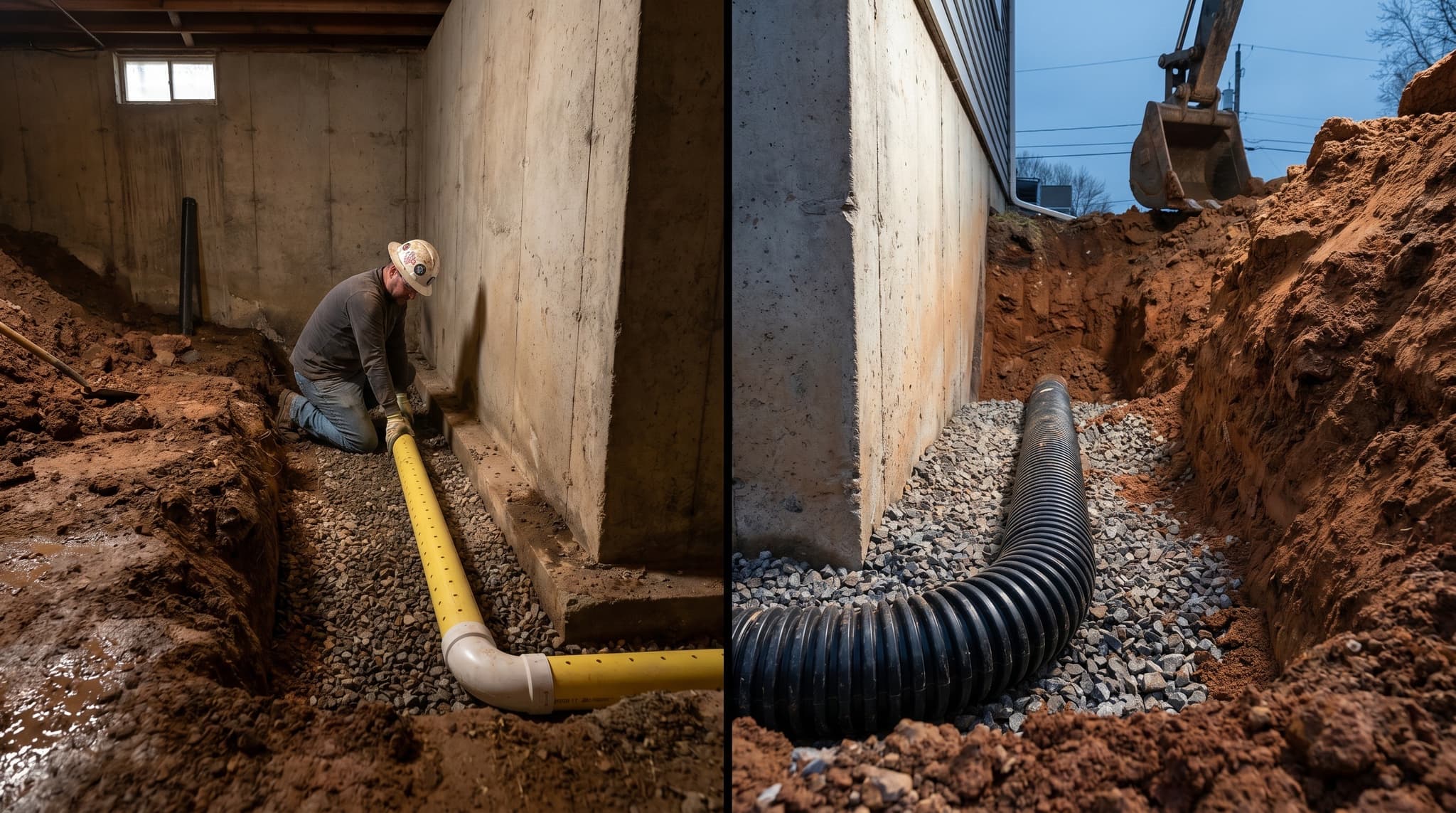
French drain interior vs exterior — comparison and decision guide
When your basement takes on water and a contractor offers you two very different paths — an interior French drain (often called cuvelage) or a traditional exterior French drain — the decision is rarely obvious. Both approaches solve the problem, but not in the same conditions, not at the same price, and not with the same impact on your property. This comparison from Imperméabilisation GSV — based on more than 30 years of jobs across Lanaudière, the Laurentides and the North Shore — gives you what you need to choose with your eyes open.
Interior vs exterior French drain — the difference in plain terms
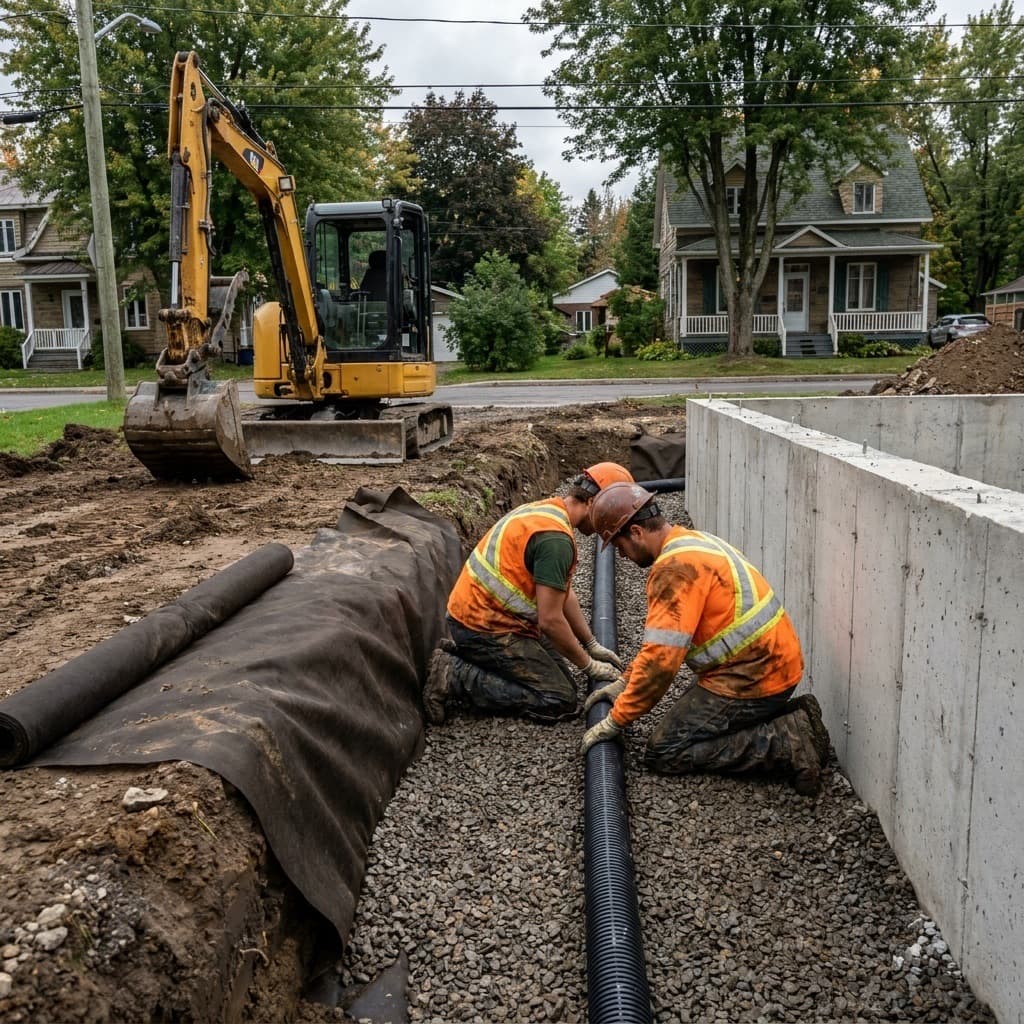
The exterior French drain is the original drain. It is installed outside the foundation, at the base of the footing, in a bed of clean crushed stone wrapped in geotextile fabric. Its job: capture water moving through the soil before it reaches the wall, and channel it to a sump, a ditch, or a storm drain. It is the solution prescribed by the National Building Code since the 1960s, and it is what gets installed on every new build in Quebec.
The interior French drain — or cuvelage — does the same work, but on the other side of the wall. We cut a trench along the inside perimeter of the basement, under the concrete slab, install a perforated drain pipe in a stone bed, and connect it all to a sump pump. Water that used to come through cracks in the wall or through the slab-wall joint is now caught on the inside and pumped back outside. Cuvelage does not stop water from reaching the wall — it carries it away before it can cause damage.
Both approaches answer the same question — how do we keep groundwater from entering the basement — but they start from opposite logics. The exterior solution treats the cause at the source: it isolates the foundation from the soil. The interior solution manages the symptom: it accepts that water will come through, but makes sure it gets captured and pumped out immediately. That philosophical difference is why an exterior drain lasts 30 to 50 years, and why an interior drain depends on a sump pump that itself only lasts 10 to 15.
How an exterior drain works
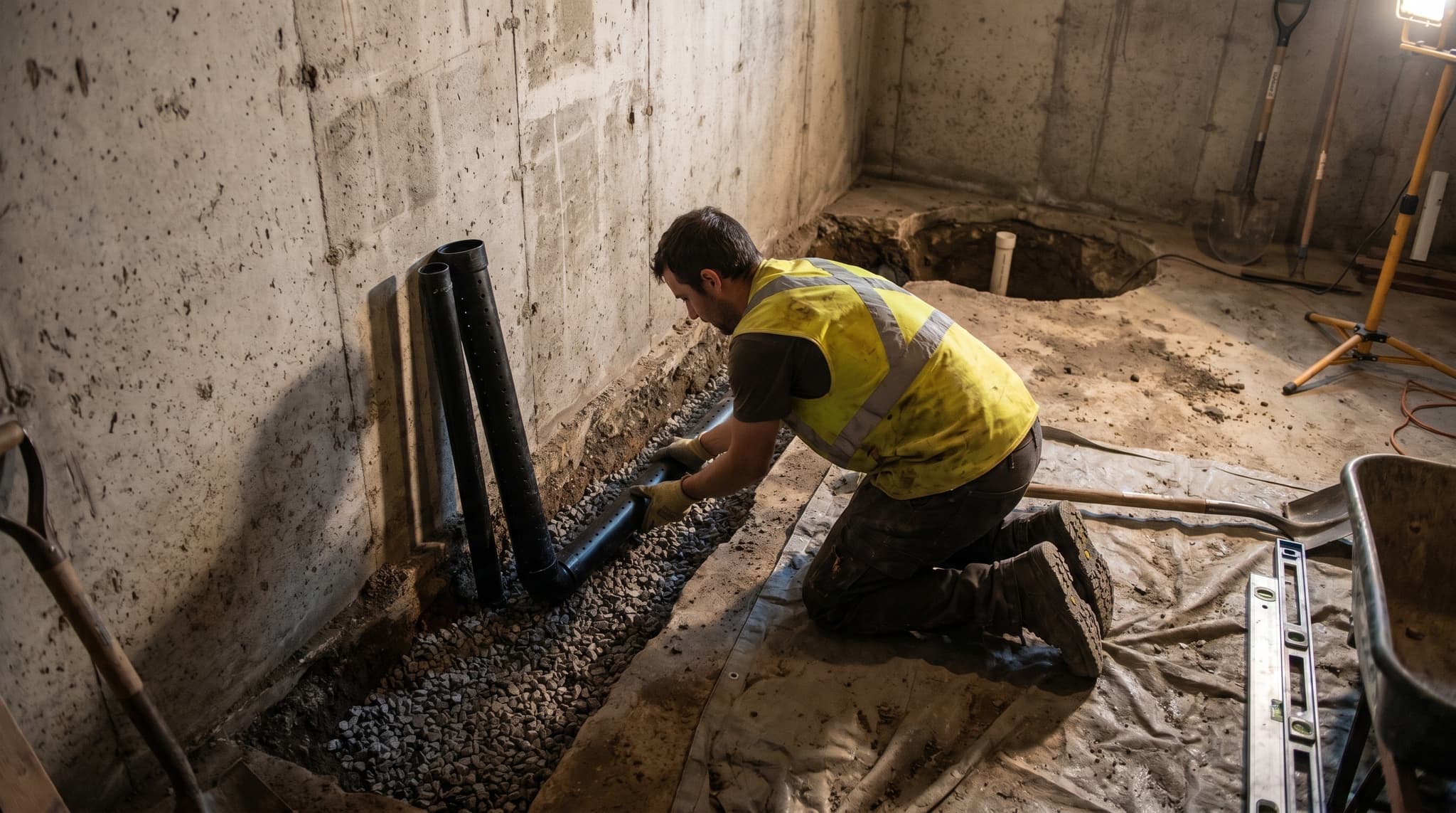
To install an exterior French drain, we excavate around the house down to the base of the footing, either around the full perimeter or only along the problem sections. We expose the foundation, clean it, inspect the concrete for cracks and porous areas, and prepare the new waterproofing: applying an elastomeric membrane or installing a Delta-MS dimpled membrane that creates a drainage gap between the soil and the wall.
At the base of the wall, we install the drain itself: a perforated PVC pipe set in a bed of clean stone wrapped in geotextile, with a continuous slope toward the discharge point. The trench is then backfilled with draining material — not topsoil or compacted clay — so water can keep moving toward the drain instead of pooling against the wall.
It is a major intervention. The excavation can reach 2.5 metres in depth, requires a mini-excavator, ties up a crew for several days, and temporarily tears up the landscaping. But once it's done, the foundation is isolated from the soil for 30 years or more, and the system depends on no electric pump to function — flow is purely gravity-fed.
How an interior drain (cuvelage) works
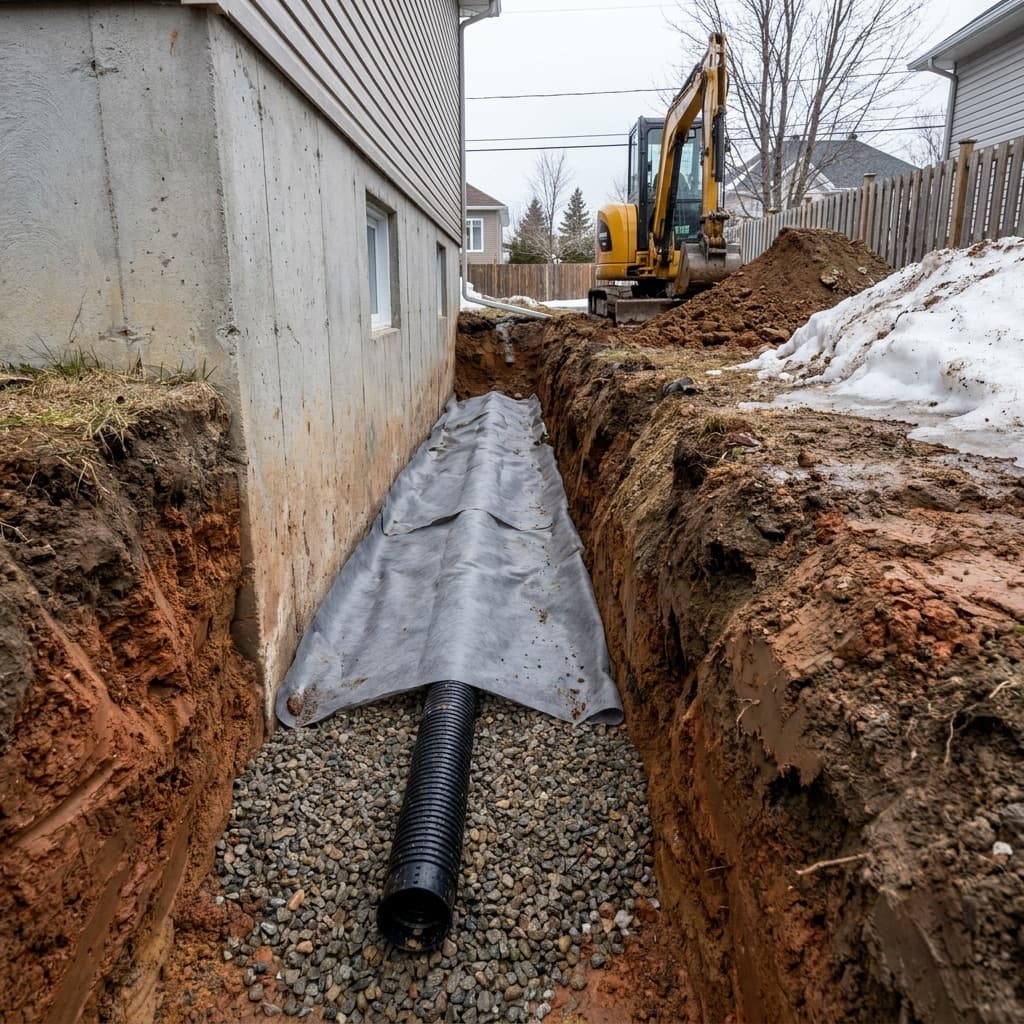
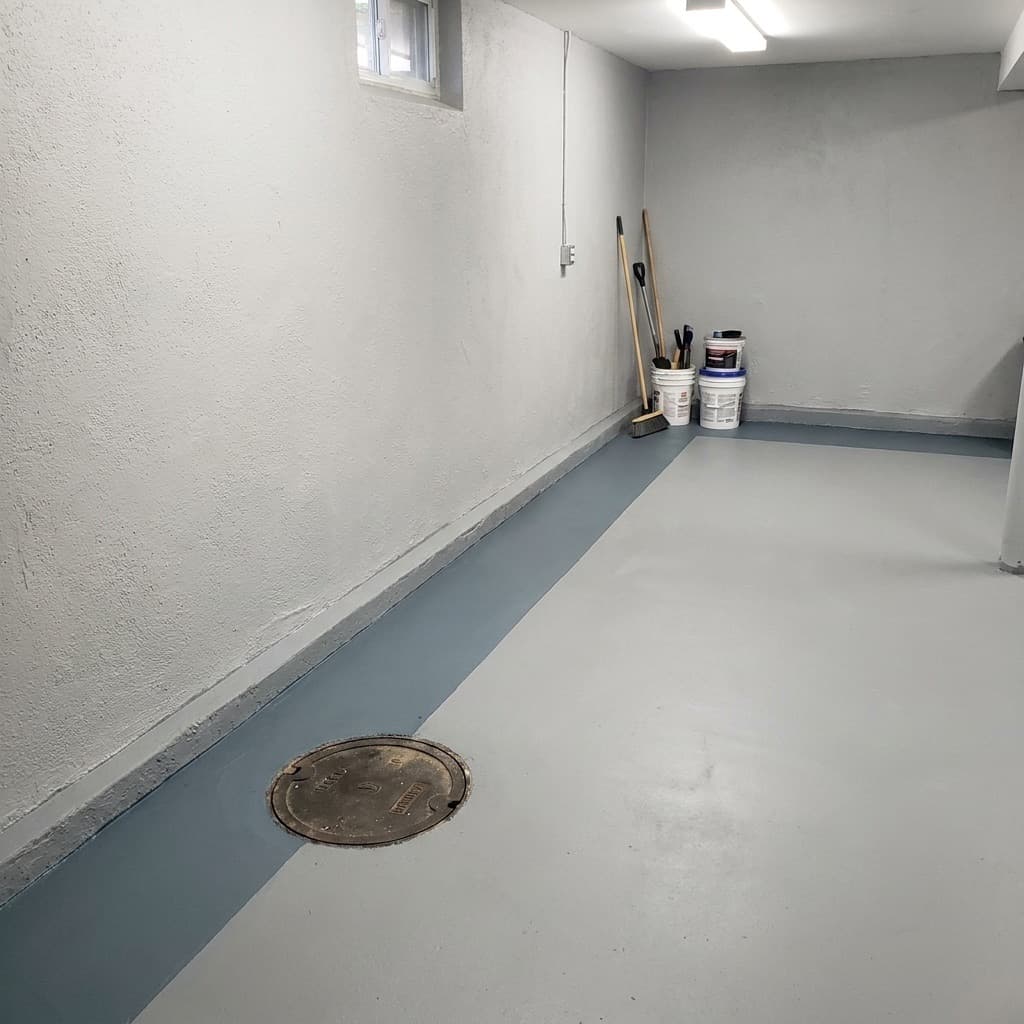
To install an interior French drain, we work inside the basement, without touching the exterior at all. We cut the concrete slab on a 30 to 45 cm strip along the inside perimeter, dig a trench under the slab down to footing level, install a perforated drain in a stone bed, and route everything back to a sump pump installed at the lowest point of the basement. The slab is then poured back over the trench.
The interior drain captures two things: water that comes through the slab-wall joint (the weakest junction in any foundation), and water that wicks up under the slab when the soil is saturated. If the foundation wall also has active cracks, they get injected from the inside with polyurethane before the job ends — otherwise water will keep coming through the cracks despite the interior drain.
The intervention is faster and less invasive for the property: no outdoor excavation, no trench across the lawn, no trees to protect, no patio slabs to redo. But it lives inside the house — noise, dust, debris to haul out — and it permanently depends on a sump pump that has to stay functional for the system to hold. A long power outage during heavy rain cancels the protection.
When each makes sense — the right context for each
The exterior French drain wins when you can excavate and you plan to be in the house another 25 years or more. It's the right call on houses that never had a drain (often pre-1960), on those whose original drain is crushed or completely blocked by iron ochre, on foundations whose waterproofing membrane is degraded, and on major renovations where the ground is already torn up. It is also the only solution that truly addresses the cause — once the exterior is redone, the inside of the basement no longer has to manage water at all.
The interior French drain wins when the outside isn't accessible: mature landscaping you don't want destroyed, a concrete or stone patio covering the perimeter, an attached garage whose slab blocks access, a neighbour too close to bring the equipment through. It is also the right call when the budget can't carry full excavation, when the house will be sold in the medium term and you want a durable solution without a major investment, or when only the slab-wall joint is leaking and the rest of the foundation is sound.
In some cases, the two approaches combine. We redo the exterior on the most affected walls, and install an interior drain on sections where excavation is impossible. This hybrid strategy obviously costs more, but it gives optimal protection on particularly compromised foundations or complex lots.
Interior vs exterior comparison
| Criterion | Interior French drain (cuvelage) | Exterior French drain |
|---|---|---|
| Relative cost | More accessible — no exterior excavation or landscape restoration | Higher — excavation, equipment and landscape restoration included |
| Project length | A few days to one week, any season | A few days to two weeks, weather-sensitive |
| System lifespan | Drain: 30-50 years · Pump: 10-15 years (must be replaced) | Drain and membrane: 30-50 years, no mechanical part |
| Infiltration effectiveness | Captures water entering at the slab-wall joint and under the slab. Not designed to stop active wall cracks without separate injection. | Blocks water before it reaches the wall. Treats the cause at the source. |
| Property disruption | Indoor work only — noise, dust, slab repour. Yard is untouched. | Excavation around the house — lawn, plants and patio slabs need restoring. |
| Ideal context | Mature landscaping, attached garage, close neighbour, tight budget, basement not heavily finished | Home with no drain or with a crushed original drain, foundation needing waterproofing, plan to keep 25+ years |
| Typical warranty | Workmanship is warrantied, but the pump is a consumable. Check exclusions (power outage, maintenance). | Long warranty on drain and waterproofing — no mechanical piece at the core of the system. |
| Maintenance | Annual pump inspection, periodic replacement, battery backup recommended | No active maintenance — camera inspection of the drain every 5-10 years recommended |
This is for you if…
This is for you if your basement is finished and you care about it
If you have invested in a finished basement — bedroom, playroom, home theatre — and you are taking on water, the interior drain often solves the problem without destroying what you've built. The trench is limited to a 30-45 cm strip along the perimeter, and finishing work only needs to be redone on that strip. With the exterior approach, the excavation doesn't touch your finished basement at all.
This is for you if you are renovating the house from top to bottom
If the house is in a major renovation — interior demolition, new basement floor, yard already torn up for an addition or new garage — redo the exterior. This is when excavation costs the least relative to the overall project, and you walk away with 30 years of fresh foundation behind you.
This is for you if the budget is tight and the leaks are minor
If the leaks remain light — a bit of dampness at the slab-wall joint, no visible pooling, no efflorescence — a targeted interior drain with a quality pump can be the right-sized solution. There's no need to redo the whole foundation for a problem that can be handled with a lighter intervention and an annual pump check.
This is for you if the house is 30+ years old and the drain has never been replaced
If your home is more than 30 years old, has never had its drain redone, and the first signs of infiltration are showing up (pump running often, basement stains, iron ochre around the sump), have the drain inspected by camera. If the drain is compromised, the exterior approach is almost always the right answer — you treat the cause rather than manage the symptom for the next 30 years.
Costs, project length, warranty
On cost, the exterior French drain is almost always more expensive per linear metre than the interior drain. The excavation eats up machinery and labour hours, and restoring the lawn, plants, and patio slabs adds to the budget. The interior drain, by contrast, saves on excavation but requires pouring a new section of concrete slab and investing in a quality sump pump. The gap depends on the perimeter treated, the depth of the basement, and the complexity of the lot. We always provide a written, itemized, no-obligation estimate after the on-site inspection.
On project length, the exterior usually takes a few days to two weeks depending on perimeter and weather — excavation does not happen in deep cold or on saturated ground. The interior usually takes a few days to a week, can be done in any season because we work indoors, and never stops for weather.
On warranty, the exterior drain typically carries a longer guarantee because the system depends on no active mechanical part. The interior drain is also warrantied, but the sump pump remains a consumable: it needs periodic replacement, and some warranties exclude failures linked to lack of maintenance or to a power outage. Always ask for the written details before signing.
And the sump pump — risk or solution?
The sump pump is the key piece of the interior French drain. It receives the water collected by the drain and pumps it out — typically to the yard at least 1.5 metres from the wall, or directly into the storm drain. Without a working pump, the interior drain overflows and the basement takes on water. That is its main weakness.
To reduce that risk, we systematically recommend a quality sump pump with a battery backup or a dedicated UPS, plus a floor water sensor connected to a cellular alert. A good installation also plans for a backup pump connection and a second pump on the line if the basement contains a bedroom or valuables. The added cost is modest compared to what the pump protects.
On an exterior drain that is properly installed and has a gravity-fed discharge point — to a ditch downslope, for example — no pump is needed. The system works without electricity, which makes it inherently more resilient to winter outages.
What home inspectors and case law say
Home inspectors in Quebec generally treat the exterior French drain as the complete solution, and the interior drain as a compensatory solution. On a sale, an inspection report that mentions an interior drain as the sole protection can influence the negotiation: the buyer knows the foundation itself has not been redone, and that protection depends on a pump.
That does not mean the interior drain is a defect — it is perfectly valid in its proper context. But be transparent in your seller's declaration: state that you have an interior drain, provide the invoices and contractor's report, and note when the pump was last replaced. Quebec case law on hidden defects is clear: a known and declared defect is no longer hidden.
If you are buying a home in Lanaudière or the North Shore, especially in a sector known for clay soils or iron ochre, require a camera inspection of the drain in your conditional offer. That is the exam that distinguishes a still-functional drain from one that will fail within five years.
Our default recommendation
When excavation is possible and you plan to keep the house for more than ten years, redoing the exterior remains the better long-term call. The system is more resilient, the foundation is protected at the source, and resale value is better supported. It is the investment that returns the most in peace of mind.
When the exterior is not accessible, or when the budget forces a compromise, a properly installed interior drain — with a good pump, a battery backup, and a water sensor — is a durable, certified, and widely proven solution. It is not a half-measure: it is another approach to the same problem, validated by 40 years of practice in Quebec.
In every case, the key is the diagnosis. Bring in a certified contractor to inspect the foundation, the existing drain (by camera if possible), the lot and the finished basement. The right choice between interior and exterior depends on your precise context, not on a general rule. Imperméabilisation GSV travels free of charge throughout Lanaudière, the Laurentides, and the North Shore to perform this diagnosis and provide you with a written, no-obligation estimate.
Myths and realities
An interior drain is just a temporary band-aid.
False. A properly installed cuvelage, with a quality pump and minimal maintenance, lasts as long as the house. It is not a shameful compromise — it is a validated solution used for decades, particularly suited to contexts where exterior work is impossible.
If we redo the exterior drain, we no longer need a sump pump.
Not always. If your lot has a natural slope toward a ditch or storm drain, yes — the system is gravity-fed. But if the discharge point sits higher than the drain (common in suburban grading), a pump is still required. Confirm the discharge point during the diagnosis.
The exterior drain is always better.
Not always. Better on the long term and on home value — true. But if excavation is impossible (neighbour, landscaping, attached garage), a quality interior drain beats an exterior drain installed in poor conditions. The right choice is the one that fits your real context.
An interior drain causes mould because the water stays in the house.
False when the system is properly designed. Water doesn't sit anywhere — it is captured by the drain in the crushed stone under the slab, routed to the sump, and pumped outside. The concrete slab and seal prevent any indoor evaporation. Mould comes from a poorly installed system, not from the principle itself.
You can install an interior drain yourself in a weekend.
No. This is a job that requires a concrete saw, manual or mechanical excavation under the slab, a properly sized sump pump, a code-compliant discharge connection, and often a municipal permit. A DIY install that clogs after two years will cost more to redo than a professional installation done right the first time.
We'll help you decide — free diagnosis in Lanaudière
The right choice between an interior and an exterior drain depends on your home, your lot, and your budget. Imperméabilisation GSV travels free of charge throughout Lanaudière, the Laurentides, and the North Shore to inspect your situation and provide a written, no-obligation estimate. Call us at 514.909.1422 or request your quote online.
Why choose Imperméabilisation GSV?
- Over 30 years of experience
- Free, no-obligation estimate
- RBQ Licence: 5596-4496-01
- APCHQ, RECQ, Réno-Maître certified
- Warranty on all work
Frequently asked questions
Need a free quote?
Fast, professional service in Lanaudière, Laurentides, and Rive-Nord