
Concrete spalling — diagnosis and repair in Lanaudière
When the concrete in your foundation crumbles, sheds particles on the surface or starts exposing the aggregate underneath, it is not a cosmetic flaw. It is a signal that the concrete is undergoing chemical or mechanical degradation that, left unchecked, eventually exposes the reinforcement and weakens the structure. Imperméabilisation GSV has been diagnosing the exact cause of spalling and applying the right repair across Lanaudière for over 30 years.
What is concrete spalling?
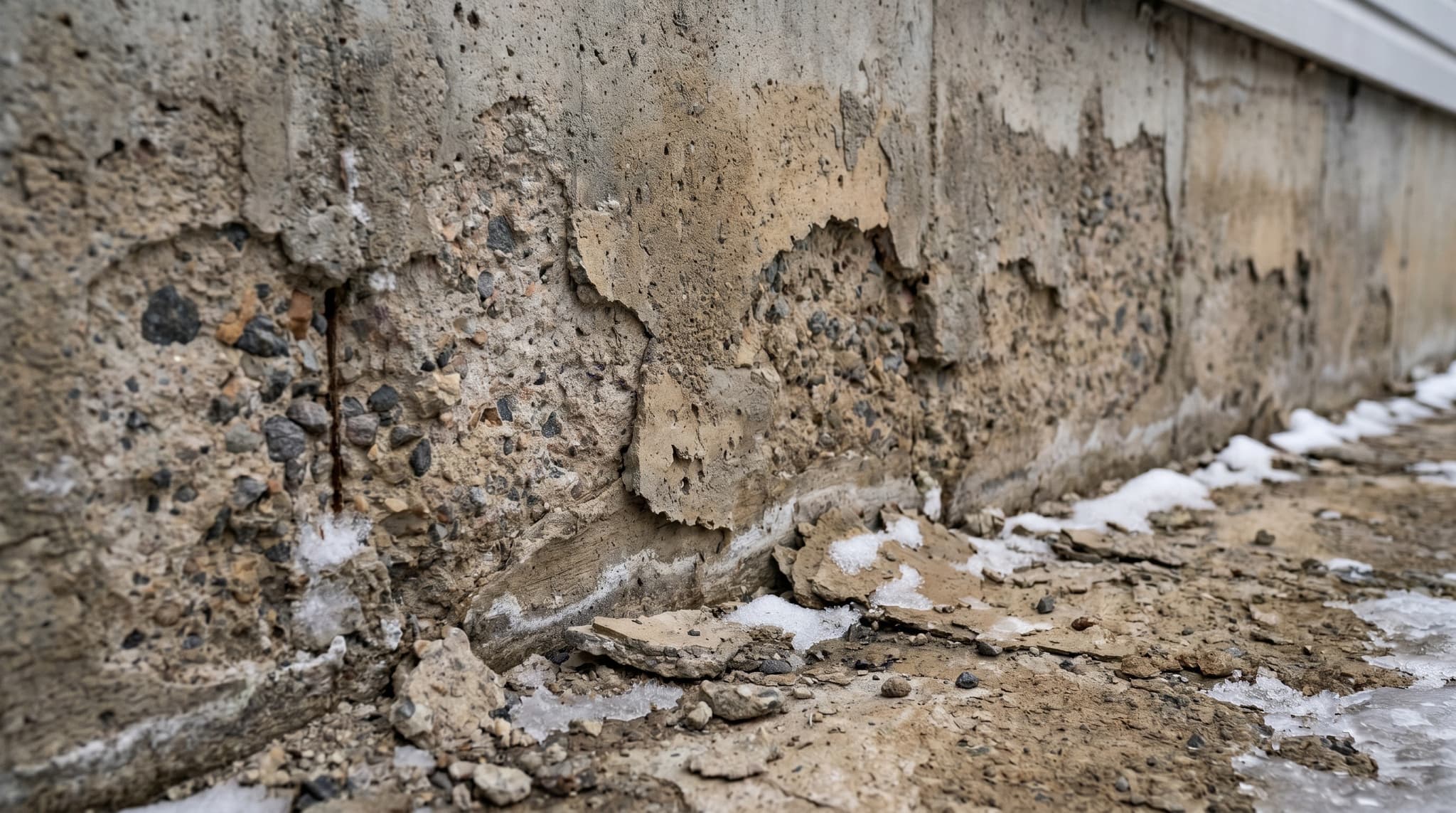
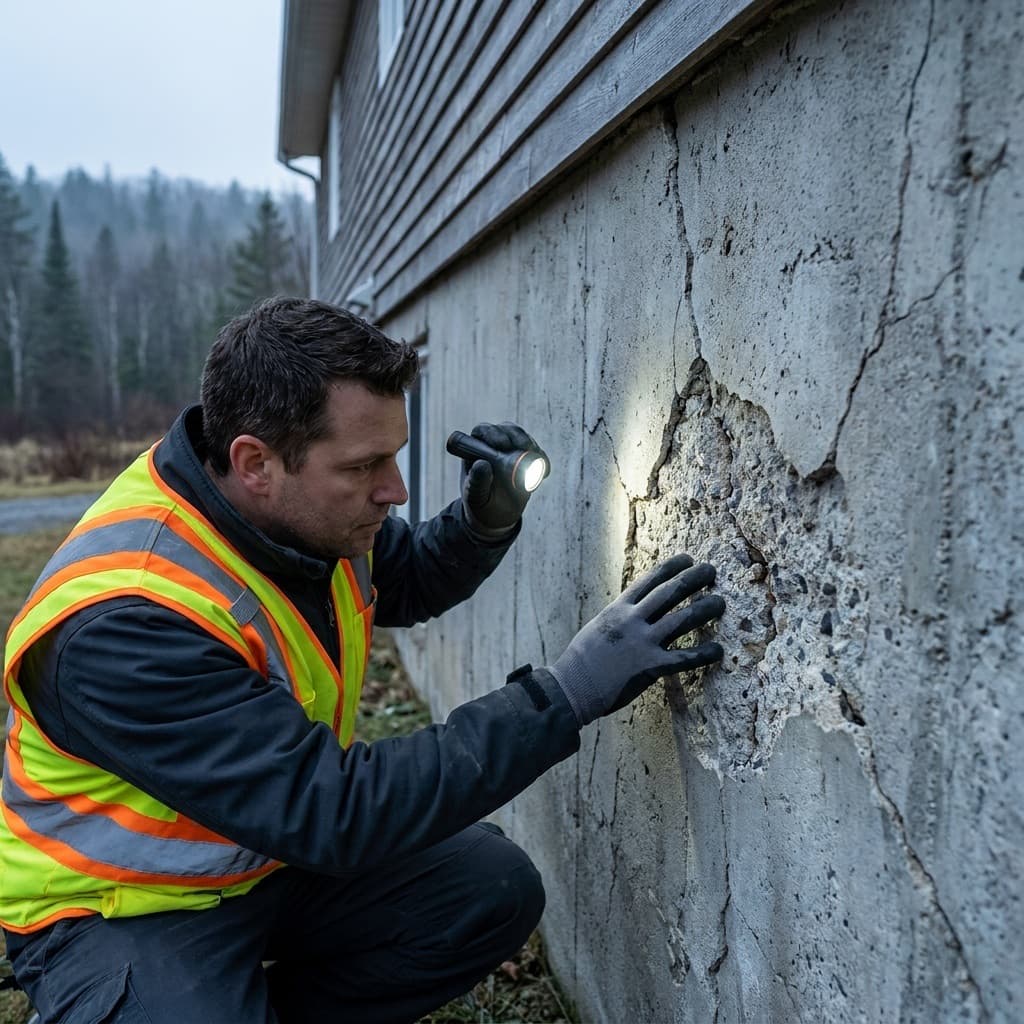
Spalling, sometimes called surface scaling or écaillage, is the progressive loss of the outer layer of a concrete element. In practice, concrete that was smooth at pouring becomes grainy, sheds particles to the touch, then exposes the aggregate (the gravel) as the cement paste binding it breaks down. On a foundation, on a garage slab or on outdoor stairs, the issue starts at the surface and progresses inward when the underlying cause is left untreated.
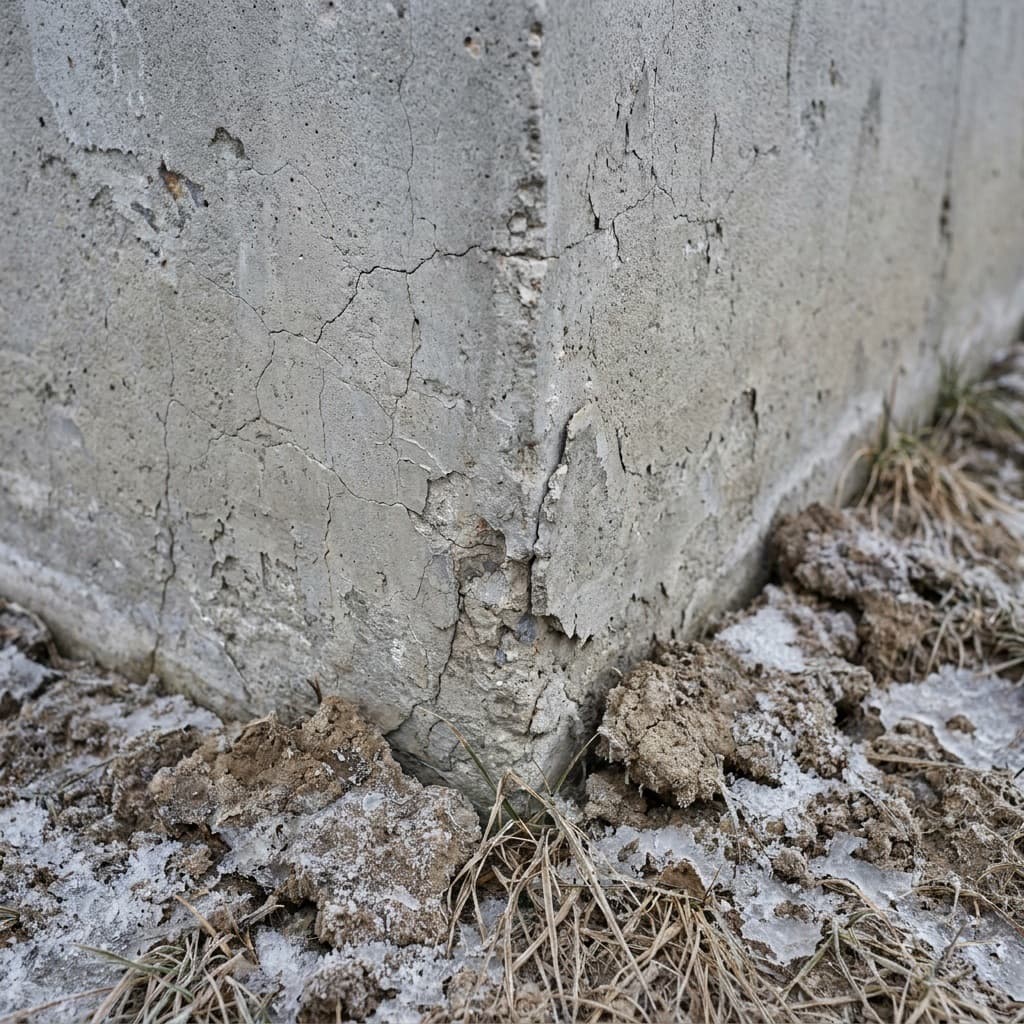
Spalling needs to be separated from cracking. A crack is a clean break through the concrete mass, which can be structural or not, and is generally treated by polyurethane injection or by reinforcement. Spalling is a surface phenomenon that affects a whole area without a clear rupture line. The two can coexist, and they often do on foundations exposed to harsh freeze-thaw cycles.
Why is spalling more common in Quebec than elsewhere? The climate. Our winters subject concrete to intense freeze-thaw cycles, sometimes several per week in spring and fall. When water enters the pores of the concrete, freezes, expands, then thaws, it fatigues the cement paste over time. Add exposure to de-icing salts, possible sulphate attack from clay soils, and concrete that was poorly mixed or poorly cured originally, and you get the perfect conditions for spalling.
How do you know if you have this problem?
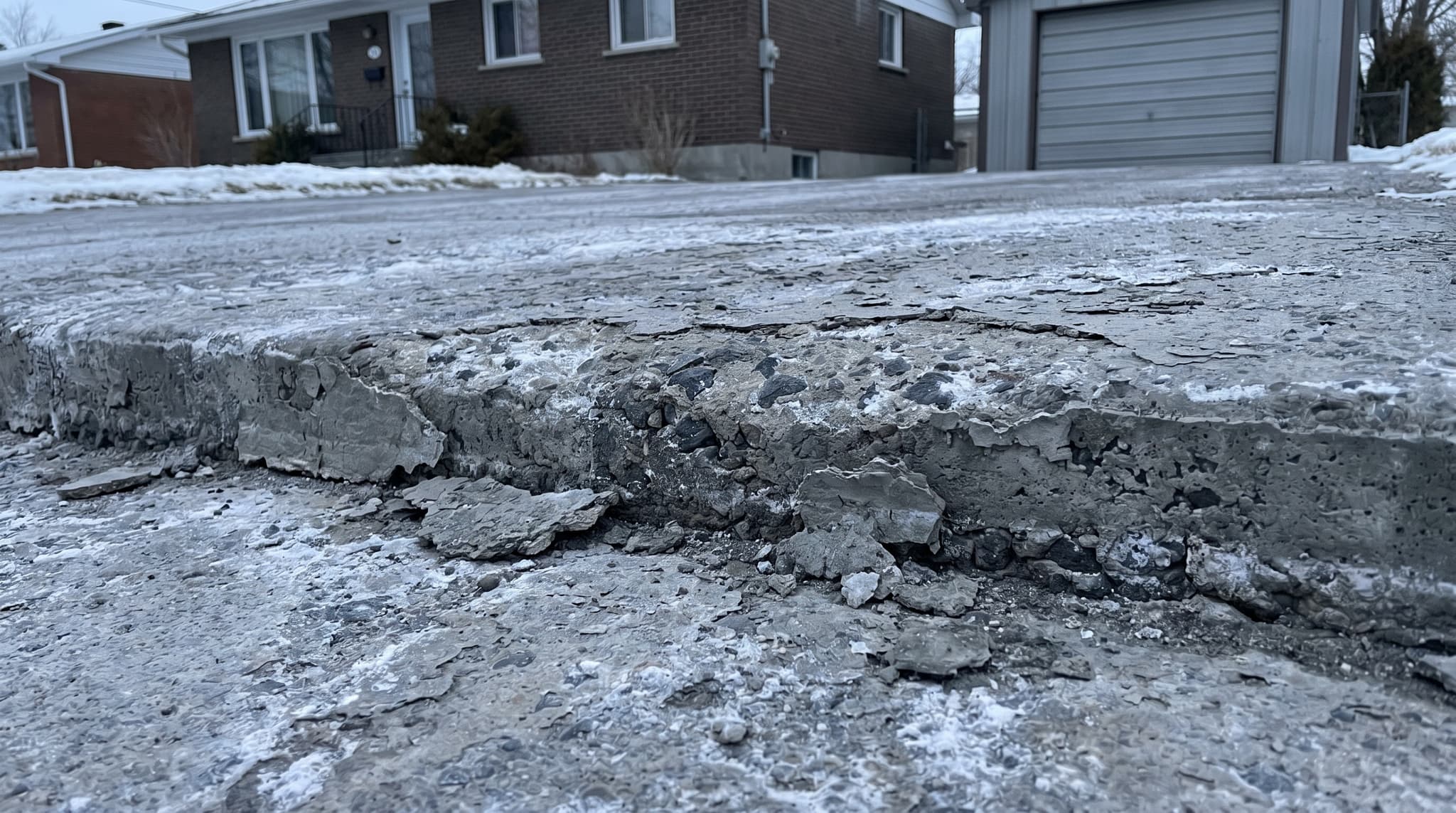
Several visual signs make spalling recognizable before it becomes severe. First, a surface that powders. Running a hand over the concrete leaves grey marks on the palm; a light scrape with a screwdriver breaks it down into small grains. Second, scaling: thin plates of concrete detach at the surface, exposing paler or rougher concrete underneath. This is especially visible on garage slabs and on foundation edges in contact with frost-laden ground.
Third, visible aggregate. As degradation progresses, the cement paste around the stones is lost, and the gravel of the aggregate shows at the surface — sometimes detaching outright. Fourth, persistent damp patches with white efflorescence: they signal that water is moving through the concrete mass, which accelerates the degradation. Fifth, on exterior foundations, the spalled area tends to concentrate at the soil-wall junction, where meltwater and salts accumulate.
Once the reinforcement is exposed, you leave the cosmetic territory for the structural one. A visible rebar, especially one already rusted and orange, means the protective concrete cover has been lost. At that stage, rust expands and accelerates the breakdown of the surrounding concrete: a self-reinforcing cycle that needs to be broken quickly. Have the situation assessed before corrosion reduces the useful section of the reinforcement.
Why does it happen?
Four main causes account for almost every spalling case we see. The first and most frequent is the freeze-thaw cycle. When water enters the microporosity of the concrete and freezes, its volume increases by close to 9 percent. Repeated expansion fractures the cement paste and releases the aggregate. Concrete with good entrained air (small air bubbles introduced during mixing) resists this much better; old or poorly mixed concrete, much less so.
Second cause, exposure to de-icing salts. Sodium chloride and especially calcium chloride used on roads and driveways in winter penetrate the concrete, lower the freezing point of the water inside and accelerate reinforcement corrosion. Garage slabs, exterior stairs and foundation walls at grade are the most exposed. A car still coated with road salt after a highway trip drops chloride exactly at the most vulnerable spot.
Third cause, sulphate attack. Some Quebec clay soils carry dissolved sulphates that react with the cement paste and break it down chemically. It is rarer than freeze-thaw but it happens, especially on buried foundations in problematic soils. Fourth cause, the initial quality of the concrete: a water-cement ratio that was too high, inadequate curing, over-troweled finishing that pulled too much water to the surface, or concrete not rated for outdoor exposure. Many of the spalling cases observed today on 1970s and 1980s construction trace back to these initial choices.
The real cost of doing nothing
Spalling rarely advances quickly, but it always advances. As long as it stays superficial, the repair cost is moderate. Once the reinforcement is reached and oxidized, you enter a very different equation: degraded concrete has to be chipped back to sound steel, the affected rebar treated or replaced, the profile rebuilt with a structural repair mortar, and the whole protected. The cost can triple or quadruple between an early intervention and a delayed repair on the same surface.
On home value, visible spalling on a foundation is one of the first defects a buyer or their inspector will flag during a visit. It almost always triggers a request for repair beforehand or a price reduction. When spalling is combined with signs of water infiltration, efflorescence and cracks, the buyer may conclude they are buying a problem — and adjust their offer accordingly, or walk away. A proactive intervention documented by a certified contractor gives the seller a concrete argument at the negotiating table.
Hidden-defect claims remain possible when severe spalling was not disclosed by the previous owner. If you buy and discover, within three years of the deed, that the foundation is heavily degraded and the defect existed at the sale without being mentioned, you can ask for a price reduction or rescission. The best protection on both sides is a documented pre-sale inspection and an honest disclosure.
False solutions to avoid
Three approaches come up regularly and rarely give good long-term results. First myth, painting over the spalling. Concrete paint applied on a surface that powders or scales does not bond properly and ends up peeling in sheets, taking with it whatever sound concrete remained. Worse, it masks the progression of the defect and prevents the concrete from breathing, which can speed up the underlying degradation.
Second myth, applying a clear sealer or surface treatment without preparation. Concrete sealers and water repellents have their place, but on already-spalled concrete they only briefly coat the grains that are detaching. The cement paste needs to be rebuilt, not just protected. A surface treatment, properly done, goes onto sound, stabilized concrete after ragréage if needed — not in place of the repair.
Third myth, wait and see. Spalling does not heal on its own, and every additional Quebec winter deepens the damage. The right reflex is to have the situation assessed as soon as you notice a surface that powders, scales or sheds aggregate. Early diagnosis usually allows a light repair, which extends the service life of the element significantly.
The right solution at GSV
The proper repair of spalling always follows the same logic: identify the cause, remove the unsound concrete, rebuild the profile with the right product, then protect the surface. Step one, the diagnosis. We assess the extent of the defect, measure the depth of degradation, check for reinforcement and its state, and identify the dominant cause (freeze-thaw, salts, sulphates, original defect). That determines the rest: the choice of repair mortar, the application thickness, and whether a complementary treatment is needed.
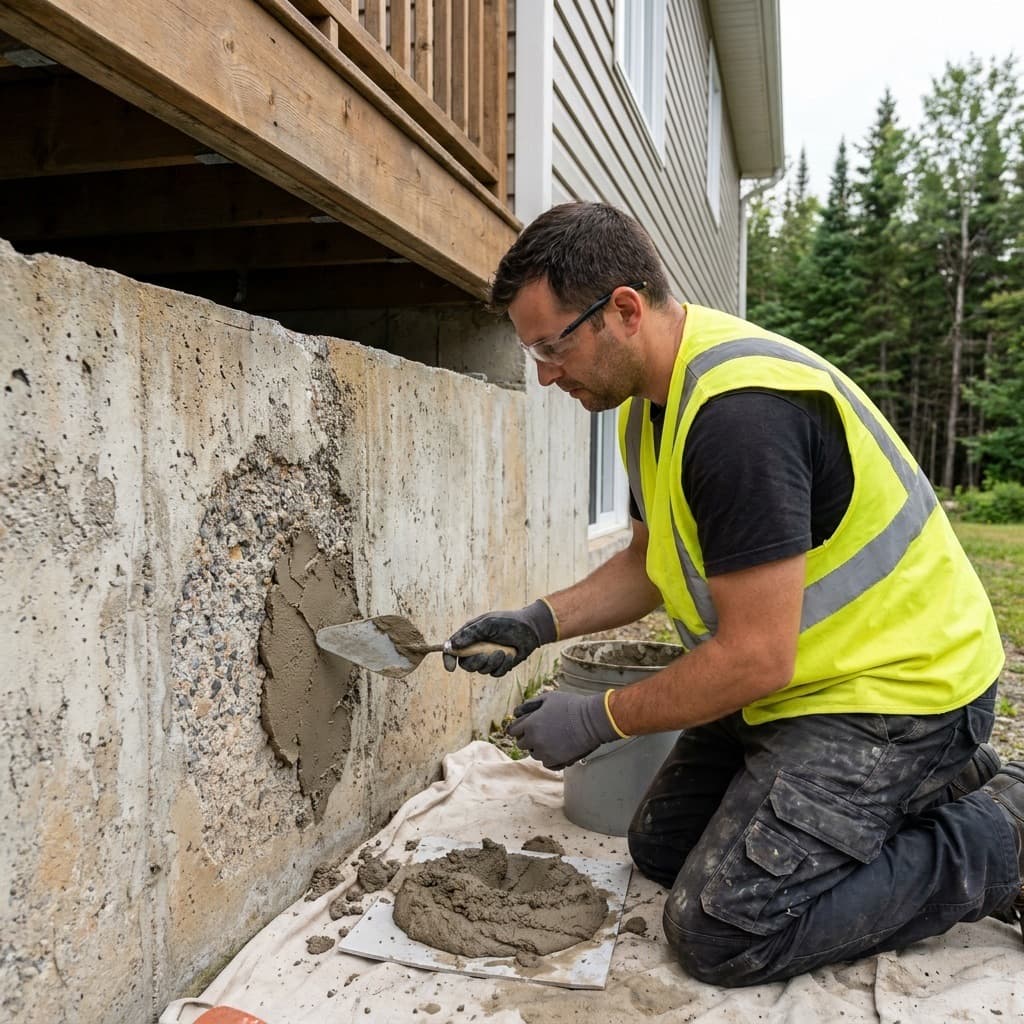
Step two, the preparation. Spalled, scaled or friable concrete is chipped back to sound concrete. This step is essential: applying a repair mortar over an unstable base guarantees debonding in the short term. If reinforcement is exposed, it is fully uncovered around its circumference, wire-brushed clean, and treated with a corrosion inhibitor or replaced if its section has been reduced too far. The surface is then dust-free and dampened to favour mortar adhesion.
Step three, the repair. We use structural or non-structural repair mortars depending on the role of the element, with an elastic modulus compatible with the existing concrete to avoid differential stress. For frost-exposed foundations, we favour polymer-modified cementitious products with controlled set times that handle freeze-thaw cycles. For horizontal surfaces (slabs), specific overlay mortars provide a finish suited to traffic.
Step four, protection. Once the repair is cured, we apply, depending on the case, a water-repellent treatment, a protective coating, or a full waterproofing membrane if the element is in contact with the ground. On foundations, treated spalling is often combined with a redo of the foundation waterproofing and, where needed, the French drain that was no longer carrying water away properly — which was frequently the original cause.
How much does the treatment cost?
The price depends on four main variables: the area to be treated, the depth of degradation, the presence of reinforcement to be addressed, and access. Here are the ranges we regularly see in Lanaudière, as a guide only — every case has its own reality.
Light repair of a vertical foundation surface, no reinforcement to address, over a few square metres: an affordable intervention, usually done in one to two days. Repair of a garage slab with moderate scaling plus a surface treatment: a few days on site depending on the area. Repair of a spalled foundation with corroded reinforcement to address over several linear metres: a larger investment, often combined with exterior waterproofing rework. Rebuilding a heavily degraded portion of foundation wall: a five-figure investment depending on extent.
We always provide a detailed written estimate after the on-site inspection, free of charge, with no obligation. The estimate clearly separates diagnosis, preparation, repair and protection — you see what you are paying for and why.
Our process
Our approach to spalling always follows the same four steps. Step one, the on-site inspection. We assess the affected element, measure the extent and depth of degradation, identify the dominant cause, and check the condition of any exposed reinforcement. We document with photos and written notes. This step is crucial: a repair mortar without correct diagnosis is a repair that comes back after two winters.
Step two, the intervention plan. Based on the diagnosis, we walk you through the applicable options in plain language, with the strengths and limits of each. You receive a detailed written estimate, no obligation. No work starts until you have formally accepted the plan. When several intervention levels are defensible, we explain why we recommend one over another.
Step three, the work. Our crews chip out the degraded concrete, treat the reinforcement where needed, apply the chosen repair mortar respecting the manufacturer's thicknesses and set times, and apply the protection treatment. The job is documented with before-and-after photos. On foundations, we coordinate with any rework of waterproofing or French drain to address the cause at the source.
Step four, warranty. All our work is covered by a written warranty handed to the customer. Our company is RBQ-licensed (5596-4496-01), APCHQ, RECQ, Réno-Maître and Delta-MS certified — all verifiable online. Over 30 years in Lanaudière give us a fast read on spalling cases, and the honesty to tell you when a light intervention is enough rather than pushing toward the heaviest job.
Service areas
Imperméabilisation GSV diagnoses and repairs concrete spalling throughout Lanaudière, the Laurentides and the North Shore of Montreal. We regularly travel to Joliette, Saint-Charles-Borromée, Notre-Dame-des-Prairies, Repentigny, Mascouche, Terrebonne, Lavaltrie, L'Assomption, Saint-Paul and surrounding municipalities.
Get a free estimate
Is your concrete spalling, scaling or exposing aggregate in Joliette, Repentigny, Terrebonne, Mascouche, Lavaltrie or anywhere in Lanaudière? Imperméabilisation GSV comes out for an on-site diagnosis, pinpoints the exact cause of the degradation and gives you a free written estimate of the applicable solutions. Over 30 years of experience, a local team based in Saint-Paul, RBQ licence 5596-4496-01, and current APCHQ, RECQ, Réno-Maître and Delta-MS certifications. Call 514.909.1422 — typically same-business-day response.
Why choose Imperméabilisation GSV?
- Over 30 years of experience
- Free, no-obligation estimate
- RBQ Licence: 5596-4496-01
- APCHQ, RECQ, Réno-Maître certified
- Warranty on all work
Frequently asked questions
Need a free quote?
Fast, professional service in Lanaudière, Laurentides, and Rive-Nord